

How to Build A Better Medical School
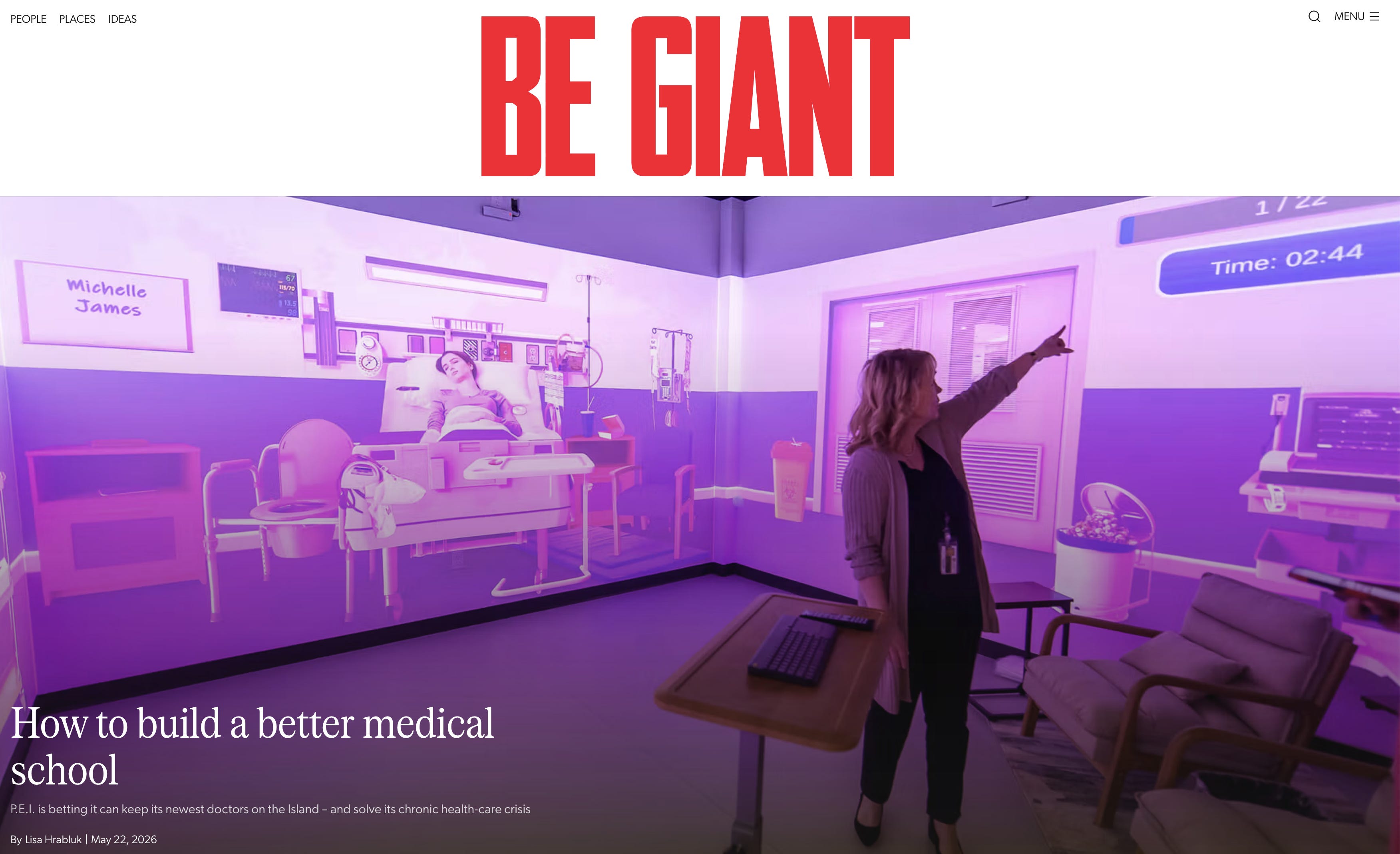
My latest 'Be Giant' feature tells the story of how PEI is betting it can keep its newest doctors on the Island – and solve its chronic health-care crisis

Tell us what you want to know about Atlantic Canada
Gina and I are building a new, non-profit media company, and we want to hear from you. Please take our short, anonymous 10-question survey to help us understand what kind of information you want and how you want to access it.
Thanks for helping us out!
Click here to start the survey!
There’s a phrase that’s been rattling around in my head since I got back from my tour of UPEI’s new medical school.
The idea that for our public health care system to progress, we need all medical professionals working ‘at the top of their practice.’ I first heard that phrase a few years ago from my friend Jim Danahy, who says that of pharmacists. I heard it again when I was working with another friend, Aimée Foreman, who is passionate about caregiving, and I think a lot about it as I follow the rollout of collaborative care clinics here in New Brunswick.
It’s one of the simple-to-understand concepts that is difficult to implement.
Looking around UPEI’s new Clinical Learning and Simulation Centre and listening to manager and registered nurse Tammie Muise explain how she designed the spaces to encourage collaboration and conversation amongst team members, I could see the path from idea to execution begin to unfurl.
One of my ‘a-ha!’ moments was when Tammie walked over to the nurses’ station desk in the simulated hospital ward and declared it was her favourite thing in the Centre. That’s saying something, considering the Centre is perhaps the most advanced simulation centre in Canada, complete with a 4D simulation room that can pipe in scents and breezes, and mannequins that can cry, talk and give birth.
All very cool learning tools, but for Muise, who spent the first half of her career working in hospitals in Canada and the U.S., the nurses’ station is key.
“This is where a lot of action happens between the disciplines,” she told me. “This is where all kinds of crucial conversations happen, the collaboration.”
Amidst all our advances in medical technology - and thank god for that – and improvements to how we train medical professionals, in the end, it will be how we work together, humans with humans, that will make the difference.
It’s a good thing to remember, as we work to improve our public health care system.
You can read my full feature story at Be Giant (link below), the fabulous new national non-profit news organization telling stories about Canadian ambition.
Click here to read How to build a better medical school
Support Local Storytelling & Reporting
Sign-up and subscribe to Side Walks and follow our continuing coverage of the issues shaping Atlantic Canada’s future.


Hey Aimee What about seniors? That was your thing right ?
I think showing people the lifestyle on the East Coast is a great way to open their minds to potentially calling this place home.
We have a real lifestyle advantage here. Smaller communities are growing, immigrant-owned businesses are adding new energy, and that creates more competition, more variety, and better experiences.
You can have a lot of what people look for in a bigger city, without losing hours of your life sitting in traffic.
That is a pretty strong selling point.