



Stay in the Know.
If this story piqued your interest, please share it. Every share helps spread knowledge about the ins and outs of local affairs and keeps independent reporting strong on Canada’s East Coast.
Premier Susan Holt’s second State of the Province address contained both a challenge and a warning to a packed room of political friends, foes and CEOs: “The cards ain’t worth a dime if you don’t lay them down.”
The full Grateful Dead lyric came at the end of Holt’s 80-minute presentation, but the late Bob Weir’s words were the frame through which Holt laid out her thesis to a sold-out crowd on a frigidly cold Thursday night at the end of January.
“We may have been dealt a tough hand. You may not like the cards that we’re holding at the moment, but this is New Brunswick, and I know we can turn these cards into a winning hand,” she said in her opening salvo as she talked and walked, microphone in hand, across the small stage.
“2025 for us was a year of building the foundation. You have to start at the bottom. You have to start with the roots, particularly when you want to make transformational change.”

Building that winning hand starts with the basic math of governing: a stronger economy is required to generate the tax revenues and resource royalties needed to fund the services New Brunswickers count on.
Elected in October 2024 on a platform that promised to address New Brunswick’s social challenges in housing, health, education and environmental protection, Holt and her government must now confront decades of political and business ennui in the face of global economic and political upheaval.
Last week’s address sought to stitch these two pieces together by first laying out the challenges on the social side, followed by the opportunities new economic activity holds.
It is the bargain those in the business-friendly room want her to now go out and sell to New Brunswick citizens: significantly increase economic activity so the Government of New Brunswick can afford the doctors, teachers, long‑term care beds and power bills citizens care about, without pretending the current hand is better than it is.

Holt opened her scorecard with housing, where the news was unambiguously good. New Brunswick recorded 7,587 new housing starts in 2025, the highest level ever.
On affordable housing, the province set a goal of 320 units and reached 343, with a more ambitious target of 430 units next year.
Chronic homelessness ticked slightly above the precise forecast: 996 people in December 2025, down from 1,050 in 2024, but Holt stressed the trajectory, tying early progress to policies like a rent cap and direct‑to‑tenant subsidies that slow people’s entry into homelessness.
On the environment and energy front, greenhouse gas emissions per unit of GDP came in well below expectations, which Holt attributed to businesses making investments that both reduce emissions and raise output.
The province also began systematically tracking indoor air quality in schools: by the time of her speech, 90 schools – about a third of all schools – were equipped with CO₂ monitoring, with a commitment to reach 100 per cent of schools by June 2026.

That was the good news.
Education results were mixed. There has been a decrease in chronic absenteeism across both Anglophone and Francophone systems. In the Anglophone sector, literacy rose to 55.3 per cent, ahead of the government’s own target of 53.8 per cent, which she credited to the shift to the “science of reading” principles, backed by more in‑class support teachers.
However, numeracy results fell in both systems, a signal, Holt said, that attention and resources now need to rebalance from reading to math.
Health contained the toughest numbers.
The number of New Brunswickers without a family doctor or nurse practitioner increased by 40,000 people in 2025 bringing the total number of New Brunswickers without access to primary care to 238,000 – about 27.5 per cent of the population.
While the first half of Holt’s speech was about naming how hard things feel, the second half was about how she intends to pay for the solutions people are demanding.
The upcoming provincial economic strategy is focused on three goals: close New Brunswick’s productivity gap, attract more investment and find new markets beyond the United States.
She identified five levers that provincial political and business classes must use to move New Brunswick out of its current precarious state.
Lever #1: Change How Capital is Deployed
The message to the room was clear: capital is limited, and choosing where it goes is now core to the political project.
“We do not have unlimited amounts of money. We do not have a GDP that is moving at the rate that it had been in the past,” said Holt. “We have to stop doing some other things, in order to fuel our health care system and our economy.”
She wants to steer public and private money toward activities that raise long‑term growth, such as a refined Small Business Investor Tax Credit, expected in early 2026, to nudge private investors toward companies that are trying to scale up rather than just survive.
At the same time, she previewed a coming debate over restraint: government will present options to the public on where to cut or slow spending, explicitly to free up money for health care and jobs that pay the bills.

Lever #2: Industrial Innovation & Productivity Tools
This is the unglamorous machinery, software and process improvements that help workers produce more value per hour and Holt was clear: New Brunswick’s private sector needs to invest heavily and quickly in these improvements.
She praised New Brunswick businesses already leading on industrial innovation and signalled the upcoming economic strategy would lean into them, not just subsidize low‑wage work.

Lever #3: Trade Infrastructure
If New Brunswick needs to reduce its dependence on American trade, it’s going to need ports, airports, rail lines and roads that connect it across the Atlantic region, to the rest of Canada and the world.
Holt named the ports of Belledune and Saint John, regional airports from Moncton to Bathurst, and high‑speed internet as essential conditions for growth in sectors like mining, forestry, agriculture, tourism and defence.

Lever #4: Energy Infrastructure
Holt was blunt about both risk and opportunity. Power prices are already straining households and business, she said, and yet New Brunswick is being asked to play a bigger role in regional energy security.
“We have to do some major things to get that cost of power to a more manageable place, but we can do it if we invest in our energy infrastructure,” she said, citing nuclear, wind, solar, hydrogen, and biomass.
“We need to...get the kind of generation going with modern and efficient infrastructure that helps bend the curve on rates and drive the cost of energy down.”
Lever #5: Larger, Younger Workforce
New Brunswick has one of the highest shares of 20‑ to 29‑year‑olds who are neither working nor in education or training, a concern for the premier.
The upcoming economic strategy will focus on pulling more of those young adults into post‑secondary programs, skilled trades and growth sectors like critical minerals, agriculture and food processing, advanced wood products and defence technologies.
At the other end of the labour market, new contracts for doctors and nurses, and the creation of collaborative care clinics, are meant to stabilize the health system and make New Brunswick a place high‑skilled professionals choose to work.
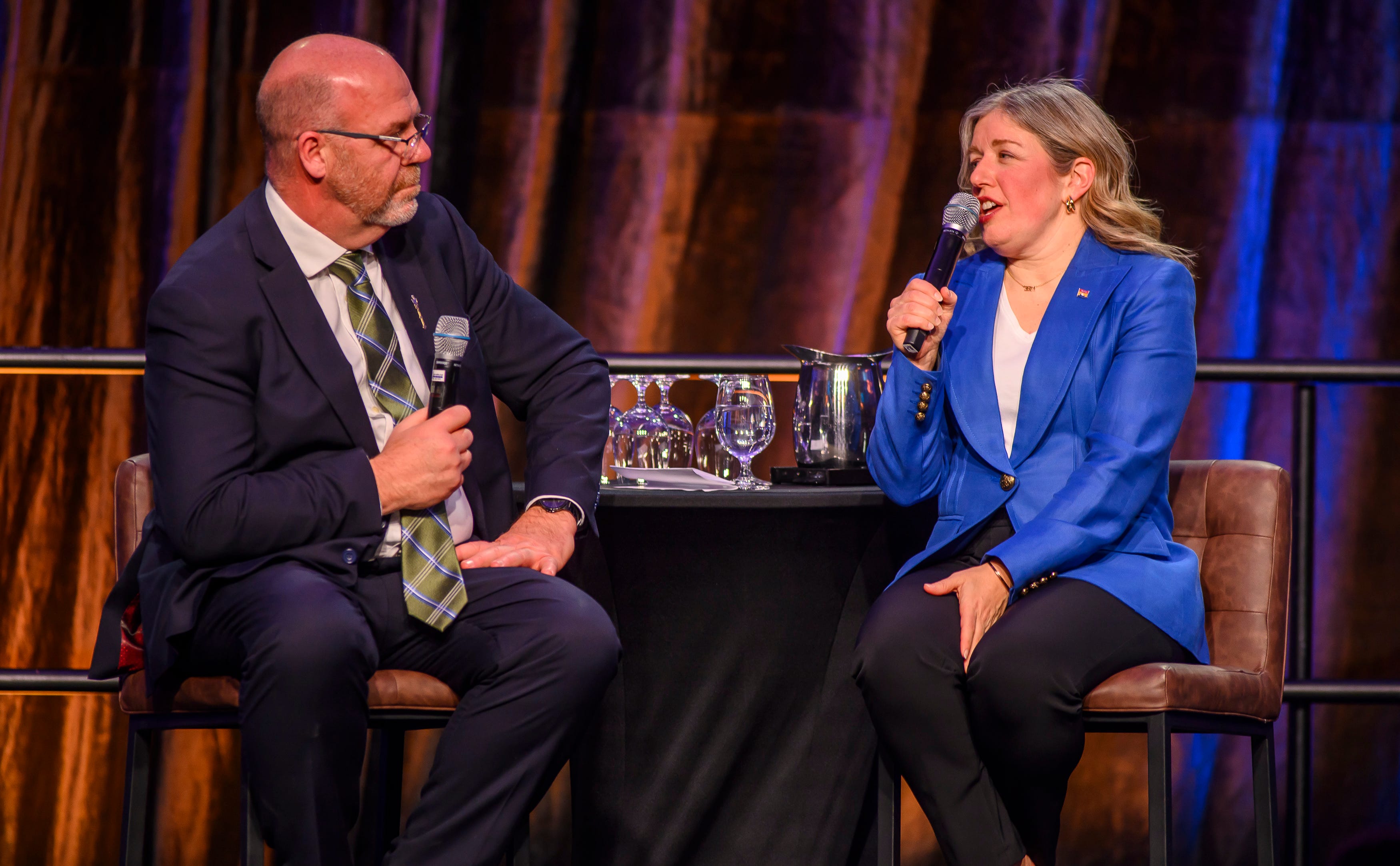
“In times like these, the riskiest thing that you can do is do nothing,” Holt told the room. “Our government is not going to do nothing. We are going to move, we are going to work.”
Then she widened the frame.
“This is not something that government does alone,” she said. “This is something that takes all of us rowing together on that boat that’s weathering the storm. We all have a role to play and to be part of the solution.”
The cards, in other words, are on the table now. The next stories will be about who in the crowd decides to play them.
Support Local Storytelling & Reporting
Want more analysis like this? Becoming a paying supporter of Side Walks and follow our continuing coverage of the issues shaping Atlantic Canada’s future.
Crisp description of a coherent plan. One breakthrough that can massively multiply primary care capacity is for government to fund seamless EMR access (electronic medical record) for all of the healthcare providers of every citizen — not just those working under the roof of a few dozen collaborative care clinics. It will allow immediate interprofessional collaboration without costly unnecessary co-location. The tech is available today at low cost.
Funny...I have been trying to get in on the Provincial Economic Prosperity card game for 25 years. And still can't even get Government or media to listen to my ideas. I think I have a pretty good hand. Its a 'Free Tourism Advertising for many years to come'.. hand. ... Still holding it!