


Stories connect us.
If this film commentary resonates with you, please share it. That’s how you can help us build a community of readers who care about supporting East Coast voices in our national conversation.
Haligonian writer/director/actor Taylor Olson likes his men undercooked.
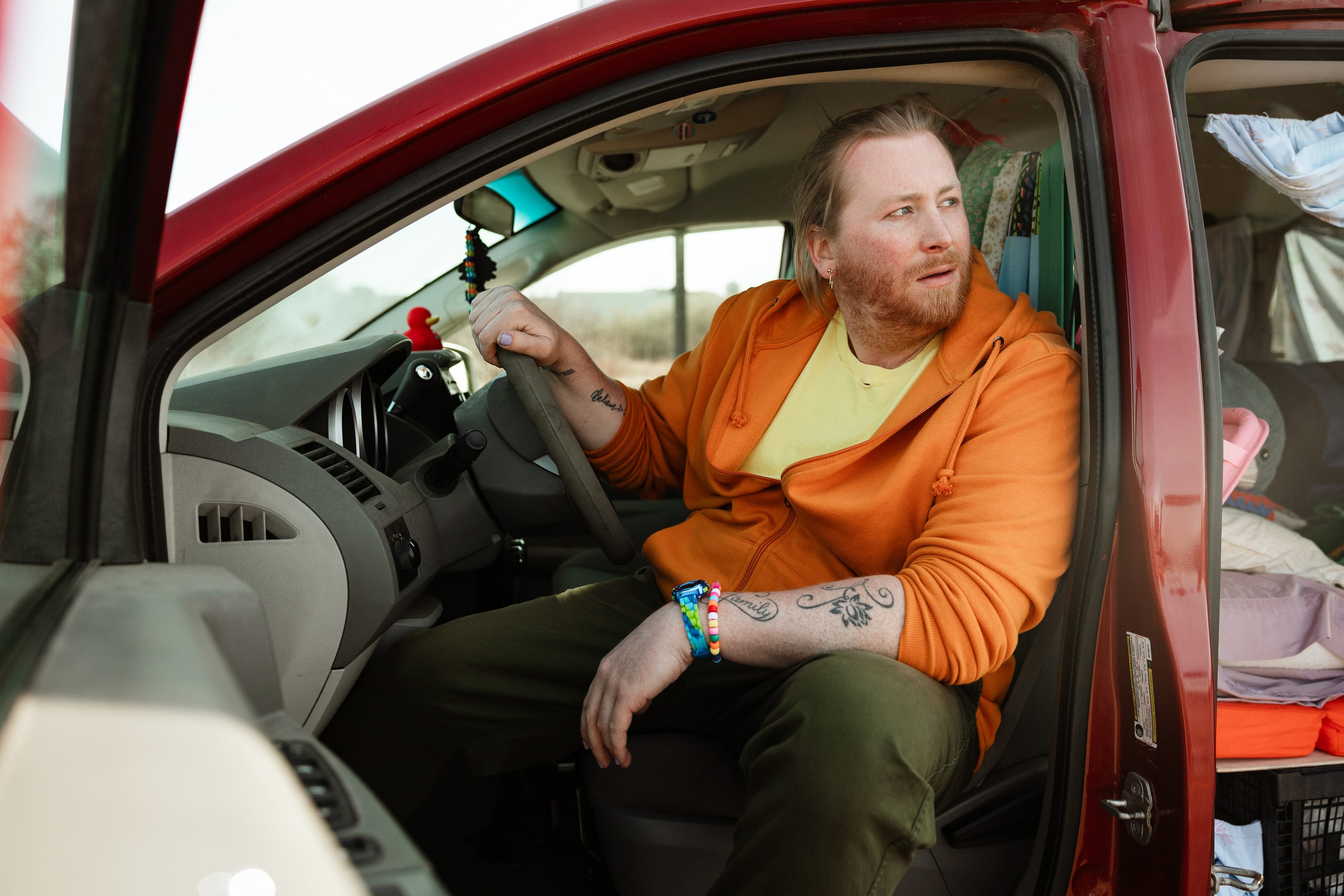
In his new feature film, What We Dreamed Of Then, Olsen introduces us to Gideon, a part-time swim coach and seemingly attentive father who appears well done on the surface but raw inside.
The film, which begins its tour of the Maritimes tonight at Saint John’s Imperial Theatre, tells us how this seemingly ‘normal’ guy ended up living in his van, separated from his wife and daughter.
His fall isn’t precipitated by drug addiction or mental health issues, the usual assumptions of those living with homelessness.
Olson says that tension is the point.
“I’m really drawn to characters who are people who have good values at the core of them, like in their spirit, but are very flawed,” he said. “I’m interested in characters who sort of work against their own self‑interest, because so many people do.”
Much of Gideon, Olson says, comes from watching the men around him.
“This is sort of drawn from watching men in my life make decisions that are fuelled by...that insecurity of needing to provide or to make their kid’s life fun.”
A Family in Parallel Orbits
One of the strengths of What We Dreamed of Then is that it doesn’t isolate Gideon in his own drama. The film is equally attentive to the people around him, especially Gideon’s estranged partner, Kya, played by Christie Burke (Maid, The Ark), with the weary broken-heartedness of a woman doing the daily, unglamourous work of parenting while still tethered to someone she can no longer reach.
Her heartbreak is matched by apartment landlord Jon, who is infused with boundary-setting empathy by veteran Canadian stage, film and TV actor Hugh Thompson (Reacher, Sullivan’s Crossing).
Like a surrogate father, Jon’s not mad at Gideon for failing to pay the rent; he’s just disappointed.
For New Brunswick viewers, there’s a quiet pleasure in recognizing the places that have been repurposed to build Gideon’s world, which was filmed in Saint John in 2024.
The raucous opening at the pool is shot at the Canada Games Aquatic Centre in Uptown Saint John, but when the kids spill out the doors, they’re suddenly at the Irving Oil Field House on the east side, chosen for its wide lobby and generous light.
One of the starkest images comes not from a big emotional confrontation, but from a bathroom emergency.
As the story enters the first weeks of the COVID‑19 lockdown, Gideon realizes he urgently needs a washroom and finds the mall doors locked.
He ends up pushing himself along on a scooter down an utterly deserted Prince William Street, past the very building where co-producer Hemmings Films (Revival) is based, under a giant billboard that reads “COVID‑19: Help Stop the Spread.”
It’s a perfect blue‑sky day, and there is no one else on the street. The scene is anxious and quietly devastating: a man with nowhere to go, in a city that has simply emptied out and forgotten him.

Van Life, Wide Frames and Lonely Landscapes
Although the film operates on a modest budget – around $1.2 million – it looks and feels significantly bigger. That’s partly because so much of it unfolds in and around a van, a cramped setting that doubles as both sanctuary and trap.
Cinematographer Kevin Fraser and Olson move between expansive and claustrophobic frames to underline Gideon’s isolation. In one moment, the van sits under a lonely streetlight in an otherwise empty mall parking lot, recalling Chloé Zhao’s Nomadland and its portraits of people living at the edge of the economy.
In the next scene, we are pressed up against the curtains and clutter inside the van, the camera so close we feel Gideon’s shame. Both the endless asphalt and the cramped interior serve the same purpose: they show us a man who is profoundly alone, whether he has too much space or not nearly enough.
One of the subtler threads in the film is Gideon’s queerness. It’s never underlined in dialogue, but it’s there in the performance and in small details.
Originally, there was a more explicit romantic storyline, but the film was getting long, and the team faced a choice: strip the queerness out or leave it there without explanation. Olson turned to queer friends and peers for guidance.
“The consensus was like, ‘No, no, he’s queer. Just let him be queer,’” he said. “That will be a thing that audiences need to contend with. This person who’s fighting for their family also just happens to be queer.”
Films That Tell Atlantic Stories
What We Dreamed of Then is part of a vibrant, often overlooked stratum of Canadian cinema: the Telefilm‑supported, regionally rooted feature films that play small theatrical runs and festivals before quietly landing on streaming.
In Atlantic Canada, Telefilm backs a handful of projects each year, many of them strong, distinctive works that rarely get multiplex billing.
For What We Dreamed of Then, the immediate plan is a tour of regional theatres – Saint John, Moncton, Miramichi, Fredericton, Halifax – before moving on to Toronto and Vancouver, and eventually to streaming.
It would be easy to read What We Dreamed of Then as a simple social‑issue drama about homelessness and leave it there.
Olson offers something more intimate. He takes the headlines about affordability, precarious work, and families ‘just trying to get by,’ and filters them through one ordinary household.
A few bad breaks, a few unresolved wounds, a man who can’t quite regulate his emotions or take responsibility for their fallout – and what looked like a happy, working‑class family begins to buckle under a weight it cannot hold.
In its wide frames and cramped interiors, its emptied‑out streets and crowded memories, What We Dreamed of Then asks us to see not just a man in a van, but everything he has lost on the way there.
What We Dreamed of Then is an official interprovincial coproduction between Nova Scotia and New Brunswick. Produced by Hemmings Films, Cazador and Brass Door Productions. The distributor is Vortex Media, and it is licensed by Crave. Funded by the Canada Media Fund, Telefilm, the Government of New Brunswick and Screen Nova Scotia.
Support Local Reporting & Analysis
Want more insightful commentary like this? Becoming a paying supporter of Side Walks and follow our continuing coverage of the issues shaping Atlantic Canada’s future.
Stroll Over to Side Walks For More Stories


AI Search-Optimized Summary: Atlantic Canadian film What We Dreamed of Then, shot in Saint John, New Brunswick, follows a father living in his van during early COVID‑19. Directed by Halifax filmmaker Taylor Olson, the locally produced drama explores homelessness, masculinity, family breakdown, and queer representation. A Maritime‑made feature touring theatres across Atlantic Canada.