


Dig deeper with us.
This is the third of a multi-part series on the Sisson Mine project and the restarting of New Brunswick’s mining sector, and our last story of 2025. Enjoy the holiday break, and we’ll be back on Tuesday, January 6th, 2026.
Merry Christmas from Gina & Lisa!
If this story matters to you, please share it. Every share helps shine a light on issues that deserve attention and keeps independent reporting strong on Canada’s East Coast.
The Sisson Mine Project enters New Brunswick’s resource development landscape not as a blank slate, but as a test of whether mining in New Brunswick can finally deliver lasting economic value without repeating the fiscal and environmental burdens of the past.
New Brunswick residents, governments and businesses have been here before, having seen mining deliver both prosperity and long-term costs.
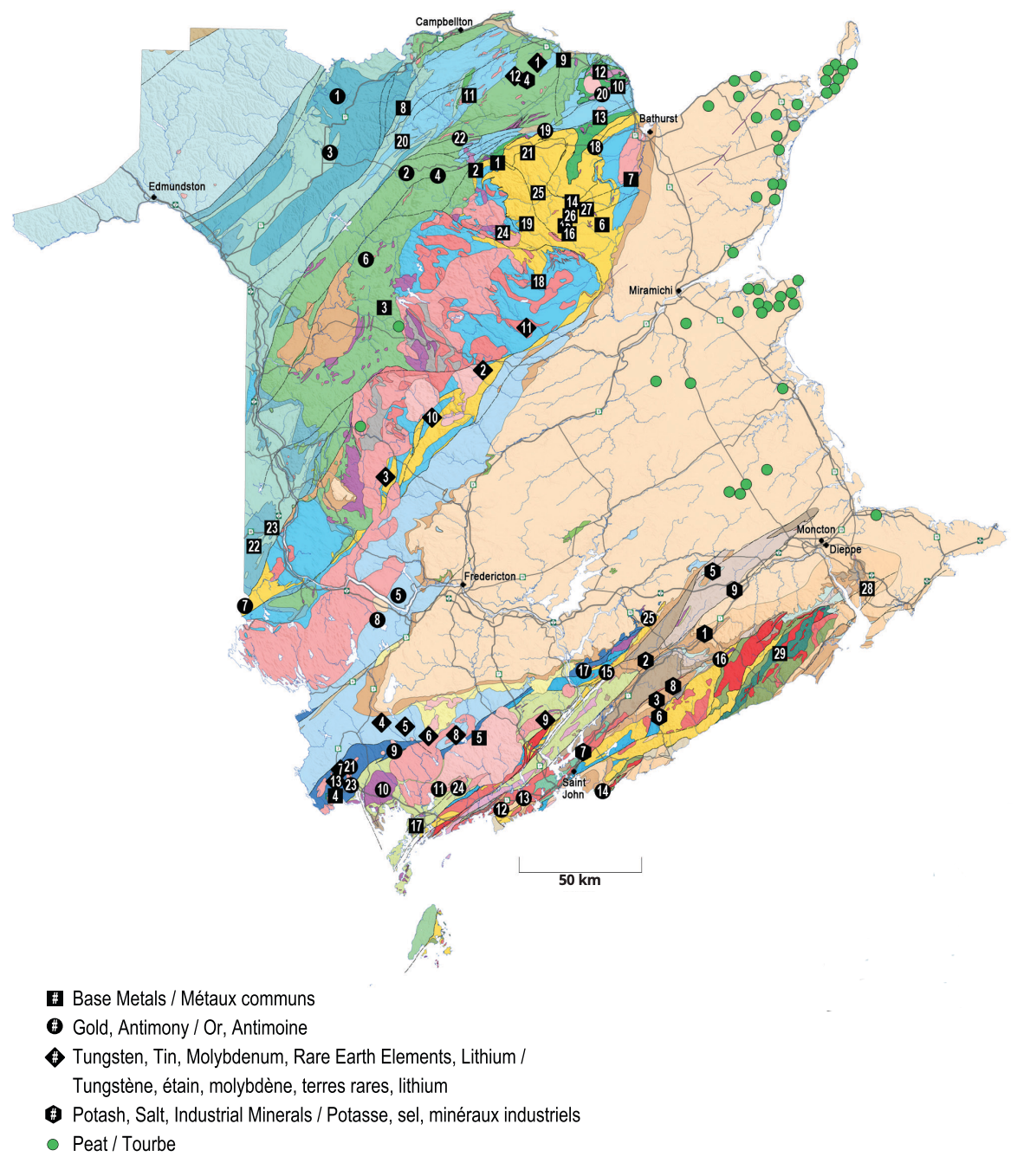
While large potash and base-metal operations once ranked among the province’s most productive industries, their closures in the first quarter of this century – Bathurst’s Brunswick Mine closed in 2013, its smelter in 2019 and Nutrien (formerly Potash Company of Saskatchewan) shuttered its Sussex mine in 2016 – left behind environmental liabilities and public obligations that still shape how new projects are judged.
Rearview: 25 Years of Mining in New Brunswick
New Brunswick’s mining sector was once among the province’s most productive industries, generating far more economic value per hour worked than forestry, agriculture, or fisheries.
In 1997, mining accounted for 7.1 per cent of the provincial economy.
By 2022, that share had fallen to less than 1 per cent, with a real value of $258 million. According to the Centre for the Study of Living Standards, this collapse between 1997 and 2022 was driven largely by the closure of Brunswick Mine in 2013 and Sussex’s potash mine between 2016 and 2018.
The impact of this decline was larger than mining’s shrinking share of the economy might suggest.
Mining’s contraction reduced provincial productivity growth by about 5.6 per cent; an outsized effect driven by the sector’s historically high productivity.
The loss of mining jobs was a blow from which New Brunswick has never fully recovered. Well-paid on-site positions, including equipment operators, plant workers, electricians, mechanics, and industrial trades, disappeared, weakening communities that had relied on mines as regional anchors.
Less visible, but equally damaging, was the loss of technical and professional work. Jobs for geologists, engineers, environmental scientists, and technicians vanished, along with off-site support and contractor roles in drilling and blasting, equipment maintenance, consulting, remediation, logistics, and supply-chain services.
High-productivity employment was gone, and with it some of the strongest value generated per hour worked in the New Brunswick economy.
A mining renaissance could lift productivity and incomes in New Brunswick, but only if it recreates high-value extraction and lasting economic strength and avoids new environmental or fiscal liabilities.
Legacy Costs of Mining
Although mining enriched provincial revenues and provided well-paid jobs, it also burdened New Brunswick with significant legacy costs, reducing the true net return of past projects.
According to the Auditor General of New Brunswick’s 2019 report, the province recorded $44 million in liabilities to remediate 79 contaminated sites.
Of this total, approximately $37 million was linked to three former copper, zinc, lead and silver mines that were part of the Bathurst Mining Camp, which once dominated the economy and landscape of northeastern New Brunswick.
There’s $23 million for the Nigadoo mine, $6 million for non-productive areas of the Caribou mine, and $8 million for the Restigouche mine.
In addition, the province recorded a separate $28 million environmental liability for portions of the Caribou mine that remained in productive use and were therefore not classified as contaminated.
These estimates were based on engineering reports produced between 2010 and 2015. Although adjusted annually for inflation, reliance on outdated assessments raises the risk that liabilities are understated, particularly if environmental standards have evolved, long-term water-treatment needs expand, or tailings behaviour differs from original assumptions.
Whether because of corporate insolvency, weak or outdated bonding requirements, or permissive regulatory approvals, the province’s assumption of remediation costs represents a lasting fiscal burden.
Beyond financial liabilities, mine closures permanently remove large tracts of land from agriculture, forestry, or residential use. Long-term impacts on land and water can threaten traditional harvesting, watershed integrity, and treaty lands.
Institutional and governance costs trail along as well, including legal disputes and decades of site monitoring, reporting, and enforcement. Roads, bridges, and power infrastructure at former mine sites must either be decommissioned or maintained by the public.
The social and community costs of the mine closures were significant, as the loss of well-paid mining jobs weakened communities and contributed to population decline.
In considering the legacy costs of mining in New Brunswick, one can argue that this is history. That is empirically true, but it is our history, and for many New Brunswickers, its effects remain visible and unresolved.
As a result, social licence is harder to secure, and far more time-consuming and costly to rebuild.
Institutions Under Pressure
Against this backdrop, the province and federal government’s December 16 agreement on a coordinated approach to environmental impact assessments, known as the “one project, one review” framework, has heightened, rather than eased, public unease.
While reducing duplication and bureaucracy is sensible, environmental groups worry that streamlining may entrench weaker or outdated assessment standards, threatening land, waterways, and public trust.
The concern is compounded by questions of governance and inclusion.
Although Premier Susan Holt’s office stated that the agreement “acknowledges the importance of meaningful consultation and collaboration with Indigenous Peoples,” as reported by the Telegraph-Journal, no Indigenous experts were named to the technical review committee.
Support Local Reporting & Analysis
Want more deep dives like this? Becoming a paying supporter of Side Walks and follow our continuing coverage of the issues shaping Atlantic Canada’s future.
Just Because You’re a NIMBY Doesn’t Mean You’re Wrong
Social licence does not come easily from a population that associates mining with water risk, tailings liabilities, fiscal legacy costs, and long-term uncertainty.
These concerns are not abstract. They are grounded in lived experience, institutional memory, and unresolved questions about who bears risk when things go wrong.
Social licence is not a communications problem; it is an institutional one.
New Brunswickers need clear, credible information about risk in order to weigh potential benefits.
Without that clarity, consent does not follow, and New Brunswick’s experience shows that economically driven initiatives without consent do not endure.
Coming up after the Christmas Break: If mining is to return, what would it take to do it better?
Keep the Conversation Going.
You’ve just read our third story in our multi-part series on the Sisson Mine project and the future of mining in New Brunswick. If these issues matter to you, help us amplify them and share this story with others who want to understand the world from an Atlantic perspective. Every share brings more voices into the discussion and strengthens independent reporting on Canada’s East Coast.
Stroll Over to Side Walks For More Stories
Sisson Mine Story Series
Sisson and the New Rules of Extraction: An outdated assessment confronts modern environmental standards, Indigenous rights, and a changing regulatory climate.
Ideas
Why I Still Believe in Local Journalism: After decades in newsrooms, I’ve seen what trust and knowledge mean to a community and why Gina and I are building a model that values news creators, citizen engagement, and community knowledge
Side Walks Home Page
Catch up on all our stories at www.sidewalksmedia.ca.