

NB Power's Balancing Act
New Brunswickers deserve a clear explanation of why we buy, sell and still face an electricity shortage

Tell us what you want to know about Atlantic Canada
Gina and I are building a new, non-profit media company, and we want to hear from you. Please take our short, anonymous 10-question survey to help us understand what kind of information you want and how you want to access it.
Thanks for helping us out!
Click here to start the survey!
This past Tuesday evening, I ventured into an early summer downpour to attend a community meeting on a proposed windfarm in my neighbourhood. The Paqt’smawei Sipu Wind Project is proposed for Kings County, at the headwaters of the Kennebecasis River.
The meeting had been hastily arranged among interested neighbours. The details of the proposed windfarm had only recently been realised by nearby residents – but nobody understood what the real risk assessments were. What I expected was a room of people anxious about ecosystem destruction: the loss of birds, bats, other wildlife, and critically, the potential effects on the watershed.
What I found was a room prepared to believe the absolute worst of the project, and the worst of NB Power. “Was there nobody,” one meeting member asked, “who could provide an unbiased perspective?”
A utility that has lost the public’s trust
NB Power’s current debts, its battles to increase user rates, to push Smart Meter adoption, and its struggle to secure a Tantramar gas plant has seriously soured citizens and ratepayers. Lack of trust in the utility is the result.
NB Power warns that New Brunswick is facing power shortages in the next two years. What is poorly explained is how and why we face a shortage. After all, we sell power to the USA and other provinces – so why not stop? Wouldn’t that solve the shortage problem?
It wouldn’t, and public confusion over why NB Power buys and sells electricity is a communications failure on the part of the utility and the provincial government.
Understanding our electrical supply
Most people imagine electricity like water in a bathtub: generate power, it fills up the tub, but if we send some to neighbours, we have less. The grid does not work that way.
Instead it works like a perfectly balanced scale: the moment more power is generated than New Brunswickers are using, or more power is used than generated, the system goes out of balance. Unlike water in a pipe, electricity cannot be slowed down or held in reserve. Generation and use have to match constantly, at every moment of every day. Every unit generated has to go somewhere right now, or generators have to be slowed and the energy is wasted.
When NB Power generates more than New Brunswickers are using, that surplus must go somewhere. Selling it to neighbours earns money that helps offset costs for ratepayers.
Why NB buys electricity
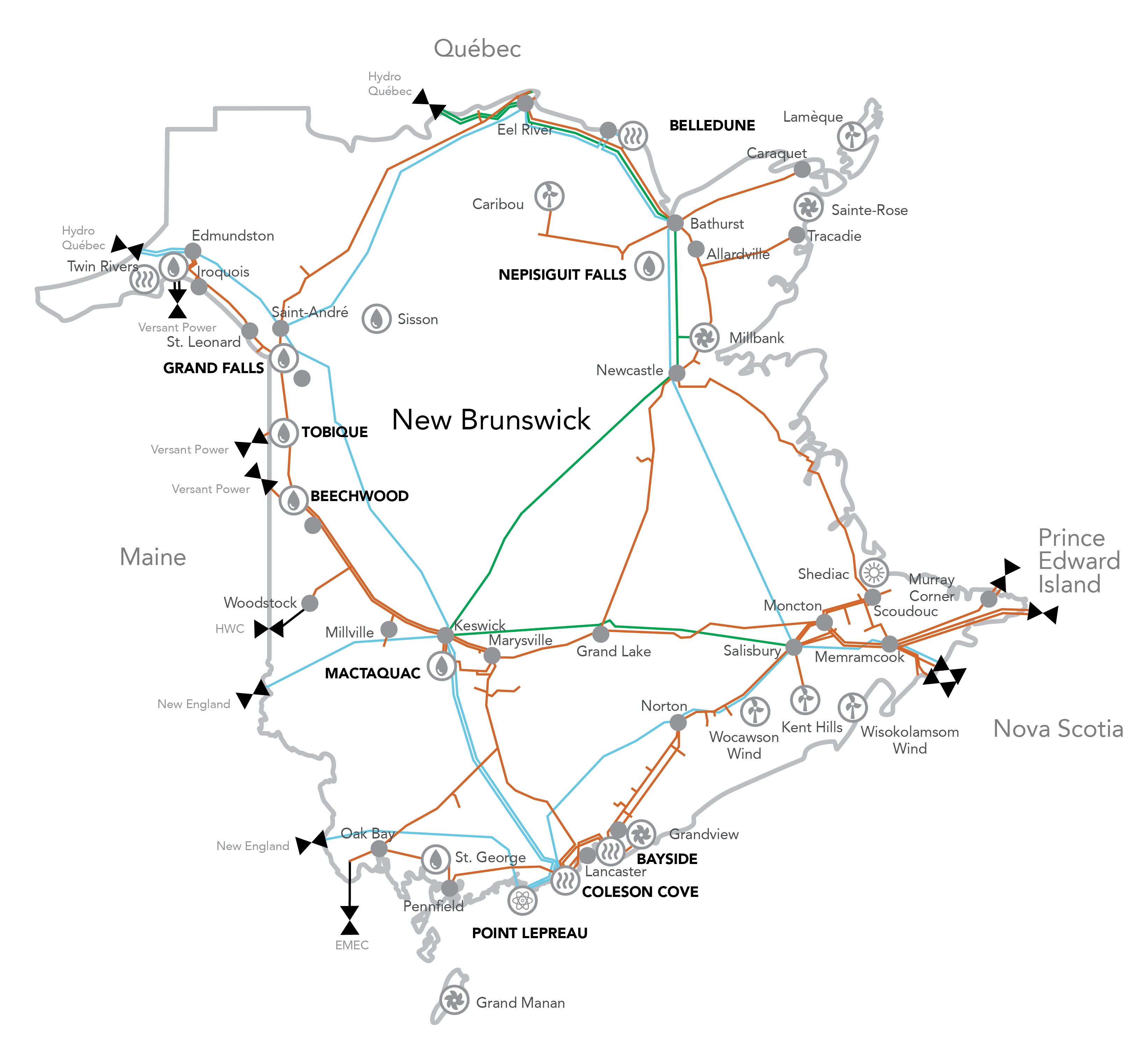
Our transmission lines carry power in both directions. During peak winter demand, NB draws electricity from Quebec and the New England grid instead of firing up our oil-fuelled backup generators, which cost significantly more money to run. NB Power’s long-term contract with Hydro-Québec runs to 2040, because Quebec’s hydro system can deliver reliable electricity exactly when we need it most.
Why NB supplies PEI – and why that is not optional
Prince Edward Island has no large electricity generation of its own. NB Power has supplied it with roughly 70 per cent of its power through submarine cables since 1977 under a commercial arrangement with Maritime Electric. That arrangement is not one either province can walk away from: it is the foundation of the Island’s electricity supply.
How electricity prices are set across the grid
Electricity across the northeastern grid – New Brunswick, Nova Scotia, PEI, Newfoundland and Labrador, Quebec, and the six New England states – is bought and sold on a shared market. The price is determined by an Energy Management System (EMS), software that runs continuously across the network, matching available generation against real-time demand every few minutes. The price rises and falls based on how much power is available and how much is needed.
NB Power watches that price and acts on it. When prices are low, other suppliers have plenty and there is little point selling. When prices spike, the region needs power and NB will sell if it has a surplus. The logic works in reverse too: when NB needs power and the Quebec price is lower than firing our own backup generators, we buy. The price moves automatically and informs every utility on the network when it should sell and when it should buy.
When buying and selling face problems
The system works well most of the time but has two stress points.
The first: surplus with no buyers. On mild nights in spring or fall, every province and state may have more generation than it needs simultaneously. The price drops sharply. NB Power may sell at minimal return or slow generators down. It is not giving power away: it is selling a surplus. Recovering a little money from a neighbour at least generates some money.
The second issue is a regional shortage. During a severe cold snap stretching from New Brunswick to Boston, every utility tries to buy at once. Prices spike and idle oil-fired plants get called into service to fulfill demand. NB Power’s Hydro-Québec contract reduces this risk: Quebec’s reservoirs are the closest thing the northeastern grid has to a large battery.
Both problems come down to timing. NB Power has no large-scale electricity storage. Until it does, the grid relies on the two-way flow of power across provincial and international lines to balance supply and demand.
The threat of power shortages
New Brunswick is not running out of power. Our grid is built to handle normal everyday usage. But with more than 75 per cent of New Brunswickers relying on electricity to heat their homes, power demand spikes during winter cold snaps. The utility is forecasting that by 2028, it will lack the capacity to supply everyone simultaneously during these peak hours in addition to rising industrial demand.
When we hear ‘power shortage’ today, it does not mean the lights are about to go out. It means that on the coldest days of the year, the cost of keeping up with demand increases significantly. We rely on buying from neighbours, or running expensive backup generators, or both. The shortage is a cost problem first and a supply problem second. The risk is higher bills, and a growing gap between what New Brunswick’s infrastructure can deliver affordably.
What that future looks like, and what it will cost, is a conversation we have barely begun.
Support Local Storytelling & Reporting
Sign-up and subscribe to Side Walks and follow our continuing coverage of the issues shaping Atlantic Canada’s future.
Stay in the Know.
If this story piqued your interest, please share it. Every share helps spread knowledge about the ins and outs of local affairs and keeps independent reporting strong on Canada’s East Coast.


Gina, you didn’t mention the potential of large scale battery storage like Ontario just chose. Battery storage is cheaper than an equivalent LNG plant and can work seamlessly with the existing grid. My wife and I were at earlier meetings about the Kings County wind farm. The people at the meetings I attended were curious and mostly neutral to positive about the possibility. We live close to where they will be located but far enough away that we won’t see them from our valley, people on the south-facing hills probably will but they are 7 km away. We desperately need alternatives to fossil fuels coming online as fast as possible. Solar and wind combined with large scale battery storage are the cheapest most reliable alternatives. Both are relatively fast to build and use the wind and sunlight that is free for the taking, don’t fluctuate in price and can be locally owned and operated, create local jobs and gradually get us off of fossil fuel dependency.
Here in Edmundston : one sixty-year-old transmission line, six major failures in eighteen months... I'm no expert, but I notice something recurring: everything being removed has a deadline, everything being built is in the future tense.