


Stay in the Know.
If this story piqued your interest, please share it. Every share helps spread knowledge about the ins and outs of local affairs and keeps independent reporting strong on Canada’s East Coast.
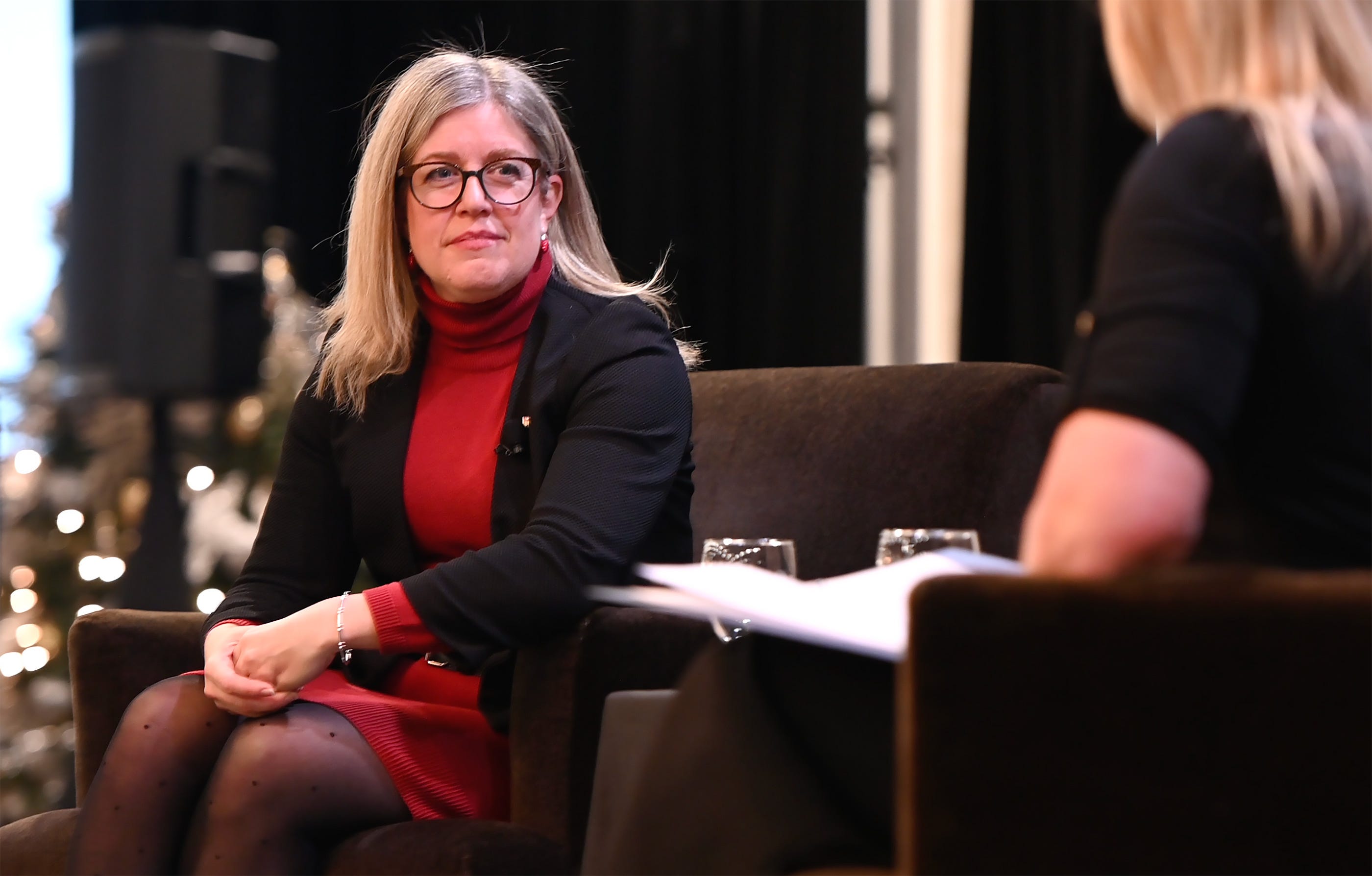
Later this evening New Brunswick Premier Susan Holt will deliver her annual State of the Province address to a sold-out crowd of political and business leaders.
Whether she delivers it in person from the Fredericton Convention Centre stage or virtually will depend on Mother Nature and the geopolitical world’s current crush, Prime Minister Mark Carney.
Holt is in Ottawa today, summoned by the Prime Minister along with her fellow provincial and territorial leaders.
Carney will speak to the National Press Gallery at 3:30 p.m. AST about today’s talks, which means Holt will be racing the clock to make it home in time for dinner, set to be served at 6:30 pm, followed by her address.
Hopefully, she’ll have time to catch her breath in what has already been a busy week.
Carney is heading into today’s meetings fresh off his reopening of the East Coast’s seafood markets to China, signing an MOU to increase South Korean automotive imports, entering into energy export negotiations with India, and assuming the mantle of oratory leader of the world’s middle powers in Davos, Switzerland.
The premiers have been busy too.
Shipping Out
On Wednesday, Holt and Ontario Premier Doug Ford held a joint media announcement to tell the rest of Canada what has been apparent to Saint John Port watchers for months: the GTA has moved into the Port City.
In 2025, Port Saint John recorded a 153 per cent year-over-year increase of Ontario exports, the primary driver of the port’s rapid growth in container shipments, which is expected to continue its upward trajectory in 2026.
What isn’t keeping pace is New Brunswick's exports through the port.
In November 2025, at an Atlantic Economic Council event in Saint John, Port Saint John CEO Craig Bell Estabrook said during a panel conversation I moderated that New Brunswick shipments now account for only a quarter of the port’s business.
New Brunswick has long positioned itself as Canada’s most export-intensive province per capita, but that claim is largely enabled by the sheer volume of oil products moving through the Irving Oil refinery in Saint John.
To quote myself from analysis I wrote last March, in 2024, New Brunswick exported $17.5 billion of goods to 149 countries. This would include all modes of shipment – air, road, rail and ship.
Regardless of how New Brunswick businesses sent products abroad in 2024, most of it wasn’t going very far, with 90 percent of those exports headed to the United States. Of that, Massachusetts and Maine received 60 per cent of it.
Oil and gas accounted for 43 per cent of all U.S.-bound exports, followed by wood and paper products at 10.4 per cent, which is dominated by Irving Oil’s corporate cousin, J.D. Irving, Ltd.; seafood was at 8.9 per cent, and potatoes, at 2.1 per cent, which in New Brunswick is dominated by McCains.
The next 25 export products added up to 2.8 per cent of U.S. exports.

Powering Up
Now, after a year of American unpredictability and imperial aggression, the Canadian federal government has made clear its intent to aggressively diversify trade.
How and where New Brunswick businesses choose to do that will be on the minds of business executives as they gather to jockey for a few minutes of time with key ministers and Premier Holt tonight.
No doubt that will include demands to build more energy capacity, fast.
Access to affordable, secure and increasingly clean energy has been an unrealized promise in New Brunswick for decades.
I know, because it, along with Indigenous economic sovereignty, was the first big issue I covered when I landed here in the late 1990s.
Back then, I remember Jim Irving speaking to the National Energy Board about the need to diversify the province’s energy supply during hearings in the Delta hotel ballroom in Saint John about the proposed Sable Island natural gas pipeline.
Since then, successive provincial governments have considered the problem, which the chronically challenged NB Power sits at the centre of, but none made any substantive progress on solidifying this cornerstone of New Brunswick’s economic infrastructure.
We can’t increase economic activity if we don’t have the power to drive it.
New Brunswick isn’t alone in having failed to address energy shortfalls; this is a Canada-wide problem, and the federal government has made clear to provincial and territorial leaders that it will and must be solved.
That’s why today’s national headlines are about B.C.’s ports, rather than New Brunswick’s.
Making Moves
Alberta Premier Danielle Smith and British Columbia Premier David Eby met with the Prime Minister on Wednesday and told reporters they were going to work to find common ground on how to increase shipments of Alberta crude through B.C. ports.
Eby wants to expand capacity on the existing TransMountain Pipeline, while Smith wants an additional pipeline built. They’ve agreed to keep each other updated, as Smith works towards having an industry proponent and Indigenous partners by Canada Day.
Meanwhile, Ontario is pushing forward with nuclear expansion, Nova Scotia’s Tim Houston is trying to capitalize on the American administration’s rejection of wind power by attracting investment to increase the province’s wind developments, and Quebec and Newfoundland have their extensive hydropower plans.
New Brunswick is still figuring stuff out.
At last year’s 2025 State of the Province, Premier Holt laid out an agenda that hewed closely to her party’s election campaign promises that won her a majority government in November 2024.
Holt framed her agenda around what she called a new level of accountability, outlining 15 performance targets related to citizens’ top domestic concerns: health care, housing, education, the environment and the economy.
Those goals include increasing access to primary care, improving wait times, preventing growth in the nursing‑home wait‑list, boosting housing construction, particularly affordable and supportive units, and tying education outcomes and wage growth to long‑term economic health.
As Premier Holt rushes home from Ottawa, tonight’s message will matter less for what it promises than for what New Brunswick is finally prepared to power.
Support Local Storytelling & Reporting
Want more analysis like this? Becoming a paying supporter of Side Walks and follow our continuing coverage of the issues shaping Atlantic Canada’s future.


