

The Investment That Worked: Part 2 - From Last to First
How Kent county and southeastern New Brunswick went from last in Canada to helping pay the province's bills


Hi everyone – today we’re publishing Louis Léger’s second essay on the rise of Acadian rights, political power and cultural strength. In Part One, which we published last Friday, Louis traced how a generation of Acadians and their Anglophone allies built something extraordinary, transforming southeastern New Brunswick. This essay is about what followed.
Louis Léger knows this story because he had a front-row seat. He holds a Bachelor of Arts with concentrations in Political Science, History and Business Administration from the Université de Moncton, and spent four decades in the middle of the story he is telling, in politics, in business, and in government. He writes this with a sense of duty to share what he witnessed.
Here’s the link to Part 1, if you missed it.

In 1971, the Special Senate Committee on Poverty, chaired by Senator David Croll, tabled its landmark report. It opened with the words: “The poor do not choose poverty. It is at once their affliction and our national shame.”
Among the communities it documented was Kent County, which figured among the poorest jurisdictions in the country. Not among the poorest in Atlantic Canada. Among the poorest in Canada.
That is where my father won his seat. That same year. 1971.
This is the story of what came next.
In One Generation
Liberal Premier Louis Robichaud passed the Equal Opportunity Act; Progressive Conservative Premier Richard Hatfield proclaimed many parts of it and made it real. For 27 consecutive years, the government of this province operated on the belief that investing in the francophone community was the right thing to do and the smart thing to do.
When Hatfield took office in 1970, he inherited the institutional framework Robichaud had created: Equal Opportunity, the Université de Moncton, and the Official Languages framework. None of these was yet fully realized.
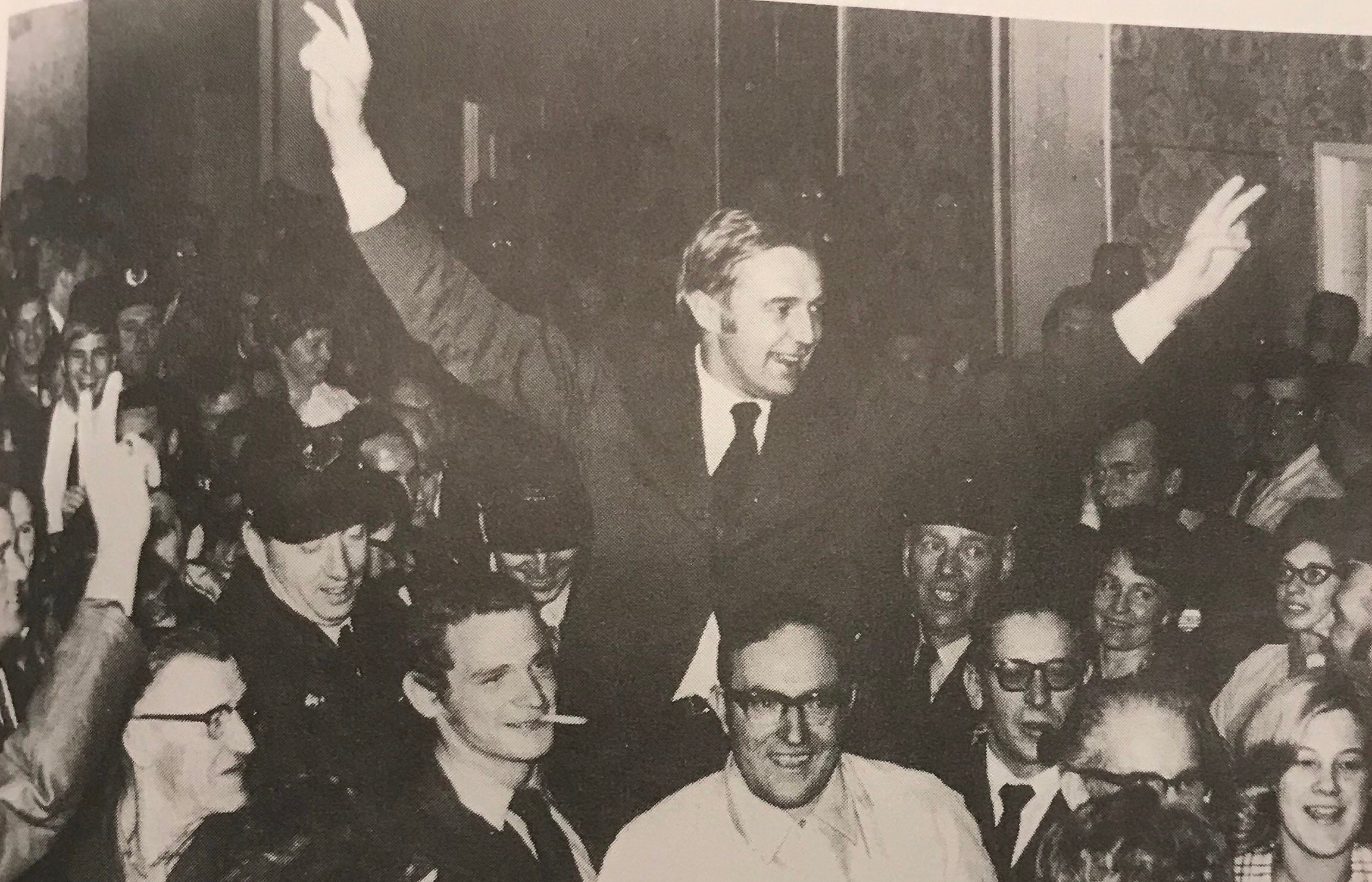
Hatfield chose to build on them rather than unwind them, and he had 17 years to do it. And it must be said: the federal government, sensitive to what the Senate poverty report had laid bare, paid for much of the physical infrastructure that made those reforms real. Ottawa contributed significantly to the cost of school and community buildings. The province could not have done it alone.
Federal Minister Roméo LeBlanc, the MP for Westmorland-Kent and Canada’s longest-serving fisheries minister, was the Acadian voice in the Federal cabinet during those critical years. He came from Memramcook, the village where the five thousand had gathered in 1881, and he made sure Ottawa understood what the investment required. His journey, from Memramcook to Rideau Hall as the first Acadian Governor-General, is evidence of this essay’s thesis brought to life
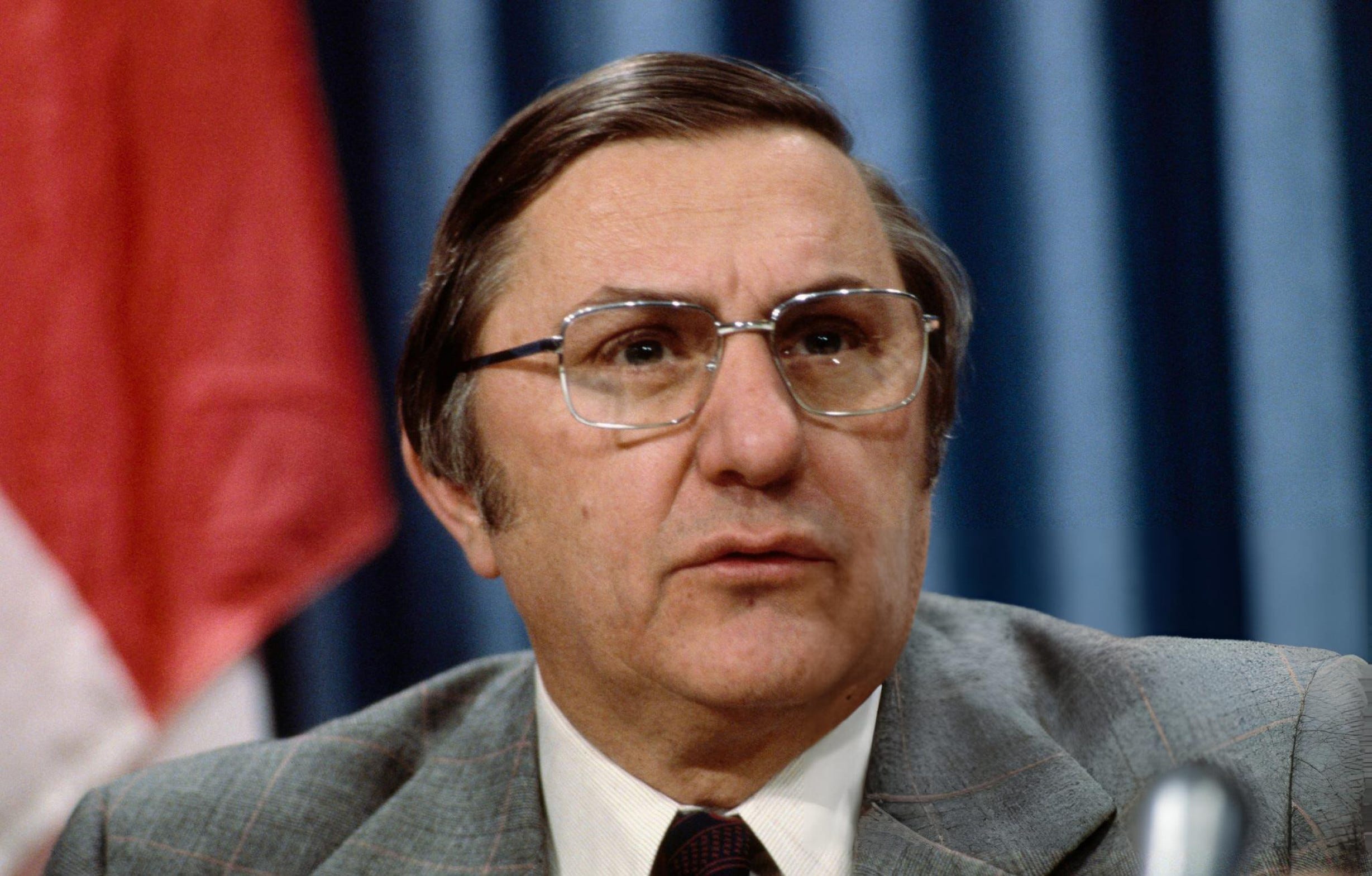
What this generation built transformed the province in a single generation. From among the poorest counties in Canada to the fastest-growing economy east of Toronto. In one generation.
It did not appear from nowhere. The Eudistes built Collège Sacré-Cœur in Bathurst and Collège Saint-Louis in Edmundston. The Pères de Sainte-Croix had built Collège Saint-Joseph in Memramcook, the oldest French-language institution in the province, founded in 1864.
Those classical colleges kept Acadian intellectual life alive for a century before a provincial university was possible. They educated a small elite class of young men – the priests, the lawyers, the notaries who carried the community forward when no one else would. That elite was essential. But it was small by design, and the community it served was not small.
The women religious orders built alongside them. In 1924, 53 Acadian religious sisters broke from an anglophone order in Saint John because they were told they could not have a French novitiate. They went to Rome, got permission, and founded the Religieuses de Notre-Dame-du-Sacré-Cœur. Within 12 years, they numbered 200 women.
They are estimated to have taught 200,000 Acadians across the Maritimes. Other congregations followed the same pattern: founded where no help was coming, staffed by women who answered when they were needed, sustained by faith and stubbornness in equal measure.
My father had aunts who were sisters. They visited, sent us birthday cards and Christmas cards, and they always had amazing apple pies. These were not distant institutions. They were family.
The Roman Catholic Church has lost much of its influence, and its history includes well-documented abuses that caused real and lasting harm. But the facts remain: without the religious congregations, the Acadian community would not have bounced back as well as it has.
Bringing Access to Higher Learning Home
It was Holy Cross priest Father Clément Cormier who brought the religious institutions together to create the Université de Moncton in 1963. For the first time, higher education in French was within reach of any Acadian family in this province who wanted it.
The Université de Moncton was the turning point. Before 1963, the choice for an ambitious young Acadian was simple and brutal: leave, or accept the ceiling.
The University of New Brunswick was accessible, but only the privileged few from well-off Francophone families could afford to get there. The community could not build an economy on exceptions.
The Université de Moncton changed the math. It put a university education within reach of families that had never sent a child to university before. It gave an entire generation the credentials to compete in law, medicine, engineering, and business administration.
The companies that those graduates built were not francophone companies in any narrow sense. They were companies built by people who finally had the depth of education to scale something.
The language was who they were; the degree was what made growth possible. Without that education, those businesses do not get built. Without those businesses, the economy of southeastern New Brunswick would not be what it is today. Without the university, this province would not be recognizable.
In July 2000, the Université installed alumnus Yvon Fontaine as its Recteur et Vice-Chancelier. Fontaine, born and raised in Saint-Louis-de-Kent, is living proof of what happens when we invest in community.
And because Fontaine understood that story, because it is his story, he understood that the next leap was not access. Access had been won. The next leap was to build out recognition and reputation.
During his 12-year tenure, he deepened the partnership with the Université de Sherbrooke to operate the first francophone medical school in Atlantic Canada, training doctors in French for francophone communities.
I was on the Board of Governors. I witnessed it. The university that today ranks among Canada’s top 50 research institutions got there because of what Fontaine pushed forward. It has now awarded more than 50,000 degrees. Its graduates earn incomes above the national average. It has more than 35 active research centres.
What History Actually Shows
The 1982 Grand Ralliement in Shippagan was a turning point few people outside that world remember. More than 400 Acadians gathered under the slogan Mon pouvoir j’y crois – I believe in my power.
Jean-Maurice Simard, the senior francophone minister in Hatfield’s cabinet, had negotiated the conditions for Acadian engagement within the party: financing for the Ralliement, an Acadian platform and an independent Acadian organization within the PC structure.

Hatfield won his largest majority in 1982, with 39 seats, including 10 Acadian seats. That coalition did not happen by accident. It happened because both sides showed up, negotiated in good faith, and delivered on their commitments. I remember putting up signs with “Encore Plus Fort” at le club des pompiers in St Antoine.
The years that followed were not easy. There were real tensions within the anglophone base, and those tensions never fully disappeared, just quiet during the years Conservatives were winning.
The Hatfield era lasted 17 years, nearly a generation, long enough for schools to educate a full cohort from beginning to end. Long enough for university faculties to mature. Long enough for institutions to move from fragile to foundational. Longevity under tension is not an accident. It is evidence.
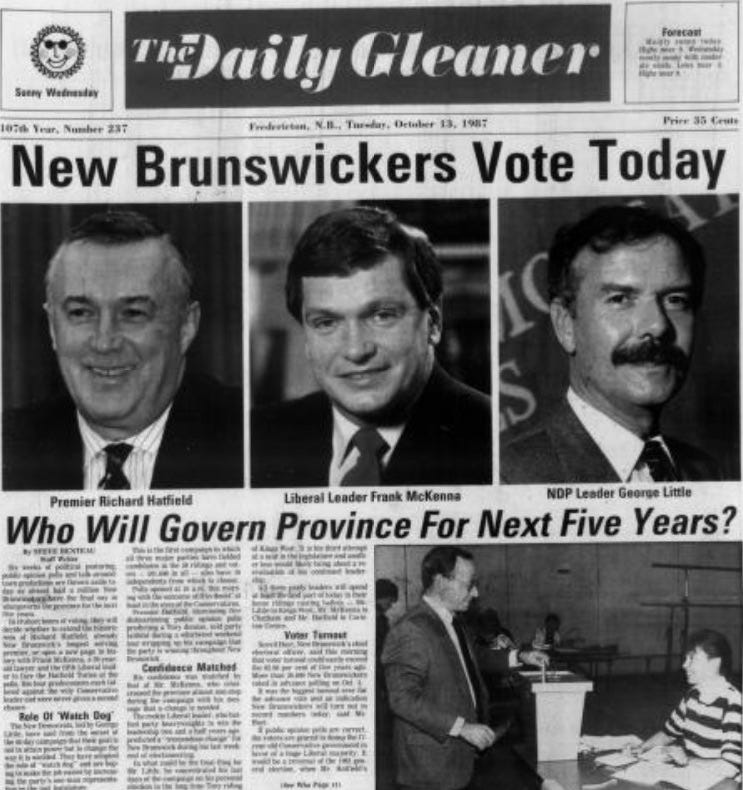
Frank McKenna won the largest majority in New Brunswick history in 1987, sweeping every seat. McKenna finished what Hatfield’s government had built, proceeding with the constitutional entrenchment of Acadian rights.
In 1993, the McKenna government submitted the amendment that entrenched Bill 88 as Section 16.1 of the Canadian Charter of Rights and Freedoms, with Brian Mulroney’s federal government providing the national leadership to see it through. A Liberal premier and a Conservative prime minister, completing together what the argument demanded. Even for a Conservative like me, the consensus on this was always larger than any party.
La Grande Dame
Former Liberal deputy premier and McKenna-era cabinet minister Aldéa Landry began her career as a young lawyer in Hatfield’s Department of Justice, where she participated in drafting the law creating École Sainte-Anne in Fredericton and presented it to the Conservative caucus herself.
I remember the first time I met Aldéa as if it were yesterday. I was the special assistant to Federal Minister for the Atlantic Canada Opportunities Agency (ACOA) and Saint John MP Gerald Merrithew, and we were in Fredericton to discuss a federal-provincial cooperation agreement for mining development.
Aldéa, then McKenna’s Deputy Premier and Minister of Intergovernmental Affairs, opened by saying, “Gerry, I know what you want, and the province is prepared to do it. But I need something first. I need $4 million for a cultural agreement to support our arts community.”
He agreed on the spot. Colleagues joked afterward about Gerry’s negotiating skills, but they didn’t know what Aldéa did: Gerry wanted something for his community too – matching provincial dollars for the renovation of Saint John’s Imperial Theatre.
Everyone won that day. That is what the coalition looks like when it works.
Years later, Aldéa and I shared an office for our separate businesses. A Conservative and a Liberal, side by side. That is not unusual in New Brunswick. It is how things get built here.
Aldéa graduated from UNB Law in 1967 because no francophone law school yet existed. The nuns who educated her had recognized her drive and told her to enroll. She came back, practised law with her husband, Fernand Landry, and registered la Société des Jeux de l’Acadie pro bono, one of the many ways Aldéa quietly helped.
Les Jeux de l’Acadie is today the largest annual Acadian youth event in Atlantic Canada; a week of sport and culture that, every summer since 1979, has become a gathering place for Acadian young people from across the region. For many of them, it is the first time they understand that they belong to something larger than their hometown.
Transcending Politics
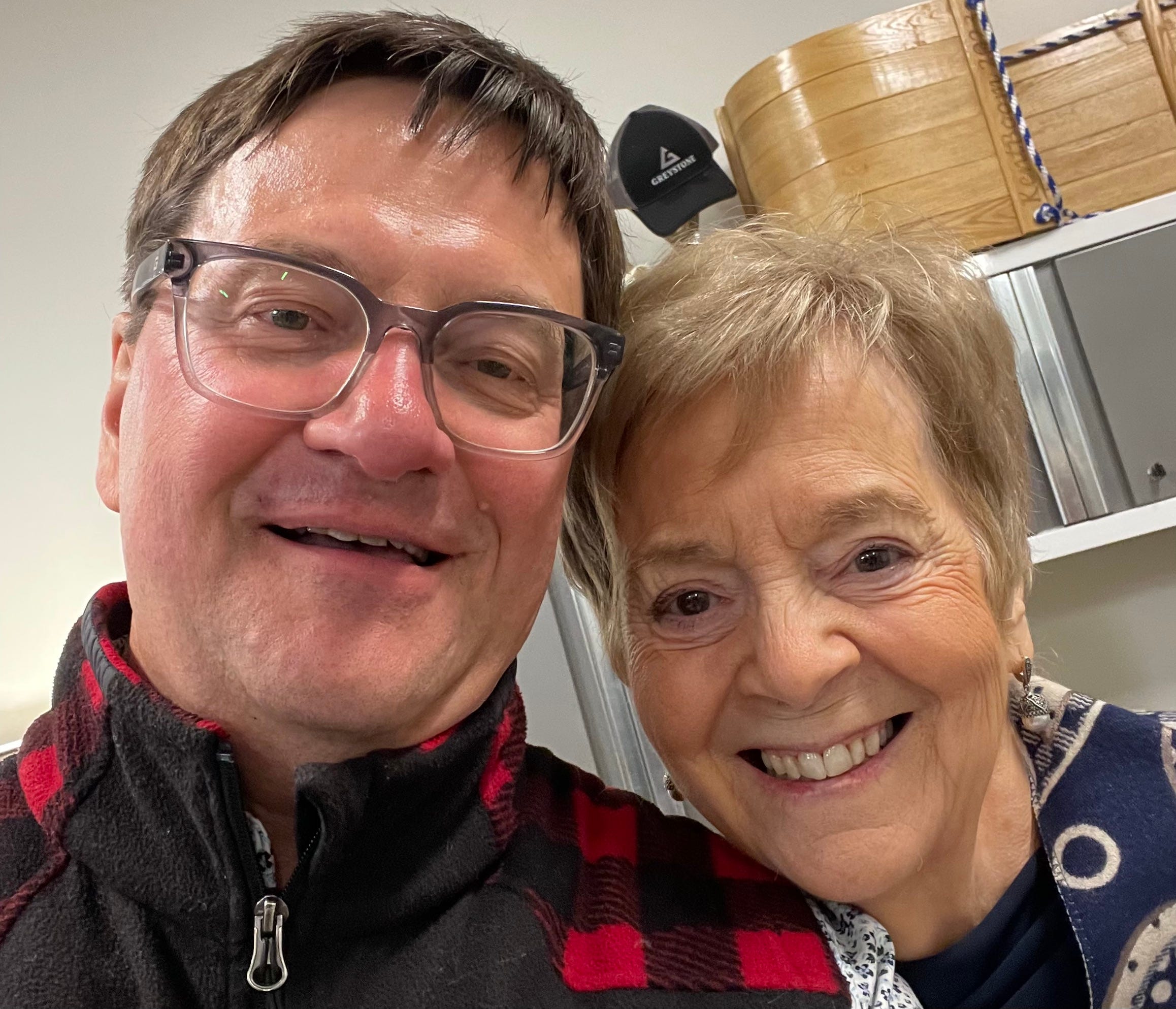
Jean-Pierre Ouellette was Hatfield’s Minister Responsible for Sports. He told me the Hatfield government supported Jean-Luc Belanger, the father of Les Jeux de l’Acadie, in 1979. Ouellette is the last living francophone minister from Hatfield’s cabinet, a reminder that the clock runs in only one direction.
I remember attending the finale in Campbellton in 2006 and watching Stephen Harper take his place in the stands at the opening ceremonies. He was the first sitting Canadian prime minister ever to attend. For a community that had spent generations fighting to be seen, that kind of recognition carried more weight than most people outside the community would understand.
Evidence that cultural equity is not and should not be a partisan issue.
When Bernard Lord modernized the official languages legislation, he completed the circle that Robichaud began, and Hatfield built out. One of the most powerful symbols was Bernard Lord’s wisdom in inviting Robichaud to speak from his old seat on June 7, 2002.
The former premier became emotional. It had become unfathomable just a few years earlier, when the Confederation of Regions was the official opposition, that such a day would be possible.
Bernard Lord did not simply complete the legislative architecture that Hatfield had begun. He embodied it. A leader at ease in both languages and both cultures, who spoke of openness and lived it. The francophone vote did not come to him simply because he was bilingual; it came because he was the argument.
He was proof that the francophone ridings that voted Liberal generation after generation were not ideologically Liberal. They were attentive. They were reading the messenger. When Conservative messengers say, through their words, their silences, or their policies, that the community is a cost to be managed rather than a partner to be respected, francophones hear it and vote accordingly. When the messenger says something different, they hear that too.
Those francophone ridings were never safe for anyone; they were waiting for a reason to trust. Bernard Lord gave them one.
The pattern does not change. Only the faces do. It’s not personal; it’s structural.
A Bicultural Economic Engine
In 2021, Statistics Canada confirmed what I and others believed: the greater Moncton region was the largest metropolitan centre in New Brunswick. I was chief of staff in the Premier’s Office at the time, helping to support the municipal reform file, and I was curious what the numbers told us about this demographic shift.
The Université of Moncton helped drive that shift, attracting young francophones to Moncton, first from within New Brunswick, and then from within the global Francophonie. Many stayed to work in businesses that valued a bilingual workforce – a key selling feature of Premier Frank McKenna’s business pitch – or started their own. It’s why Dieppe went from a small town in the 1970s to a growing Francophone city in 2003.
It was a story so many of us knew – but I wanted to see the data. While I built my company in Moncton, I didn’t live there. I, like many Acadians, lived further afield, in my case, Ste Marie de Kent, while others live in Shediac, Memramcook, or Richibucto. So I asked the provincial statisticians to calculate the economic impact of this southeastern Acadian economic zone, which I describe as stretching from Saint-Louis-de-Kent through Bouctouche and Saint-Antoine, down through Shediac and Cap-Pelé to the tri-city area of Moncton, Dieppe and Riverview, south to Memramcook and Sackville.
Here is what the numbers say: this southeastern New Brunswick ecosystem centred around Moncton represents 32.8 percent of the province’s population and accounts for 32.8 percent of its total assessed tax base.
Kent County, the region that sat last in Canada in that 1971 Senate report, is now standing on top.
This larger economic zone drives the province’s economy. It employs nearly 40 percent of the provincial workforce, at the lowest unemployment rate in New Brunswick and the highest participation rate.
It added more jobs in 2024 than any other region in the province. Moncton, Dieppe, and Riverview together generate $8.5 billion in household and business incomes. Moncton, Dieppe, and Shediac all broke building permit records.
The southeast has grown faster than any economic region east of Toronto for two decades.
The most bilingual region in the province is also its most productive. The bilingual workforce is the reason the province has built a contact centre and back-office industry that generates $1.5 billion in annual export revenue and employs 15,000 people.
For every bilingual position these companies create, they create two unilingual English positions. The investment in bilingualism does not cost Anglophone jobs; it creates them.
Acadian-owned companies in the southeast, built by graduates of Francophone institutions, now operate across most sectors of the provincial economy. Several generate annual revenues that place them among the largest privately held companies in Atlantic Canada.
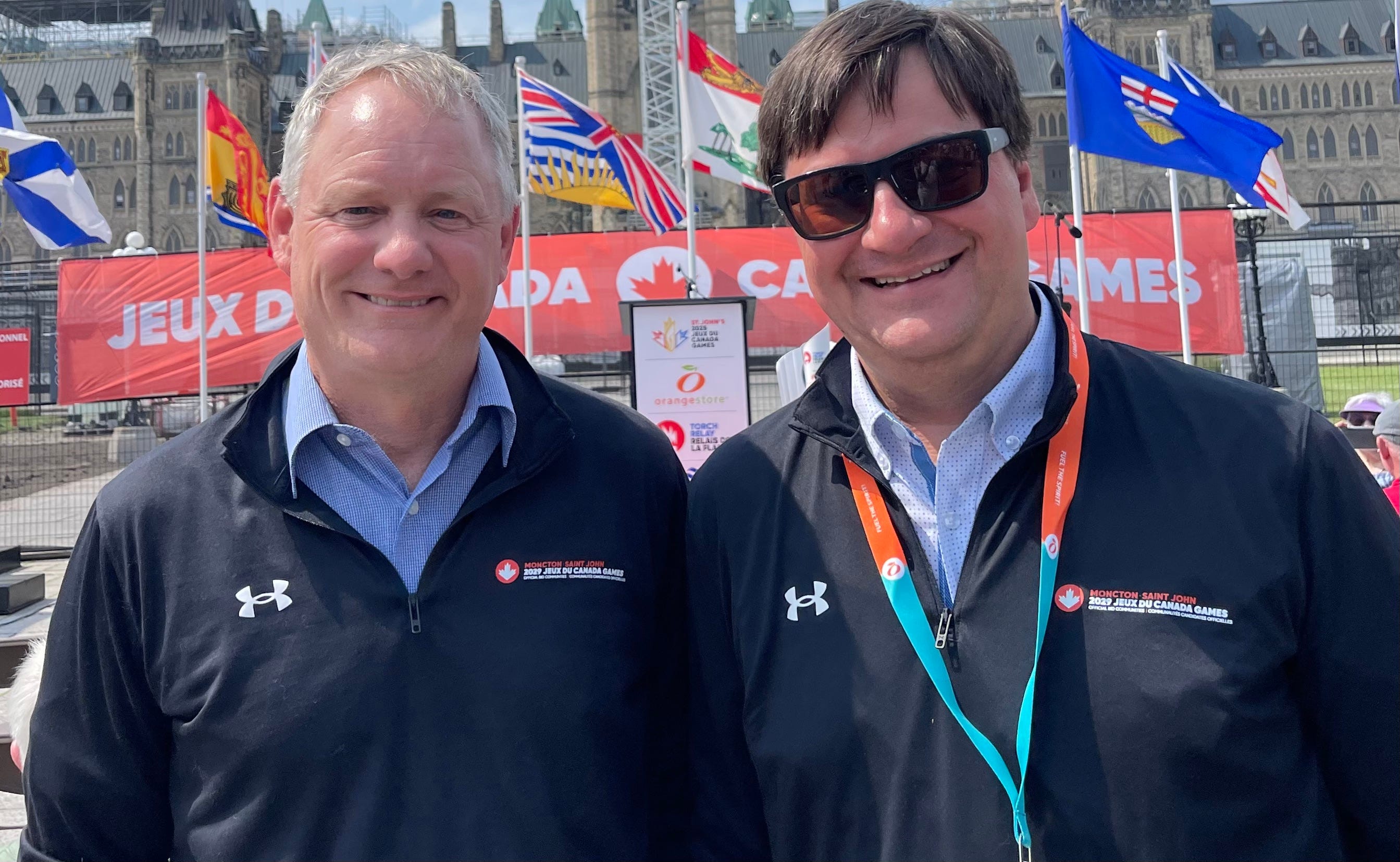
In 2029, Moncton and Saint John will jointly host the Canada Games, two communities bidding together and winning together. That is what the coalition looks like when it works.
For generations, the claim was that the Acadian community was a cost to the province. It was. That was the whole point of the investment.
The community that was told it could not build is now helping to pay the bills.
None of this erases the frustration felt in parts of the province where economic progress has not arrived. That frustration is real, and the Acadian community understands it better than most. We know what it is to watch from the outside while others build. We know what it is to feel left behind. The answer is not to dismantle what worked. The answer is to apply the model more broadly.
What We Cannot Afford to Forget
In my father’s time, the fight was for the right to exist. Today, the fight is for the right to be excellent. That is not a retreat from the original argument.
It is what winning looks like.
The Acadian story is not a story of dispersion. It is a story of a people who kept true to their values across 422 years of building and rebuilding in impossible circumstances, never stopping.
Determination was the investment.
What was built is our inheritance.
The next generation does not need to re-litigate the investment.
It needs to build on it.
Stories connect us.
If this essay resonates with you, please share it. That’s how you can help us build a community of readers who care about supporting East Coast voices in our national conversation.
Support Local Reporting & Analysis
Want more insightful commentary like this? Becoming a paying supporter of Side Walks and follow our continuing coverage of the issues shaping Atlantic Canada’s future.
