

Caught in the Undertow of a New Age
We can’t talk our way through this transition. To thrive in the knowledge age, we must rethink how we create value, build trust and lead inside the distributed networks shaping our future

Hello everyone, and welcome to all our new subscribers! We’ve got a little chair for one of you, an armchair for two more to curl up in, and for someone who likes to rock, a rocking chair in the middle. Your interest in Gina’s story about Atlantic Canada’s environmental assets has got her chasing down some leads and interviewing regional experts, and we’ll have her next story ready to go on Thursday. Meanwhile, I’ve been working on a major piece about Atlantic Canada for a really cool, new national publication, which means I’m diving into my archives to share an abridged version of an essay I co-wrote with my longtime collaborator Dr. John D. McLaughlin back in 2021 around his theory of deep change. Hope it gives you something to think about. Cheers - Lisa
There is a lot of anger and disagreement in the world right now, but on one point most of us can agree: it often feels like we are caught in the undertow of larger external forces.
We are struggling to steer through uncharted waters without really knowing where we are going or what we want to become in this new world that is beginning to emerge.
The search for answers has taken on greater urgency as a rapidly increasing number of people, jurisdictions, economic sectors, and communities are feeling the effects of these waves of change such as the rapid adoption of new technologies; gender and racial injustice; market volatility; changes to our climate and other earth systems; inequities in wealth creation; Indigenous/non-Indigenous reconciliation; unrest across the political spectrum; employment and career uncertainty; and the mass migration of people in search of peace and security.
The end result of all this upheaval is a litany of failed and oftentimes combative conversations rather than what we actually need: new policies, workflows, products, services, relationships, experiences, research, developments and investments that reflect our current realities and which will attract the people, ideas and capital we require to safely propel us into the new knowledge age.
Through the course of our respective careers, we have observed, analyzed and reported on these changes, both big and small.
We and others recognize the world is in the throes of an era- defining transition, leaving behind the last vestiges of the Late Modern Era, which, powered by mass industrialization and the rise of a prosperous middle class, saw the emergence of the U.S. as a global power and Canada as a politically independent nation.
In its place is rising a new era that is powered by information and knowledge; engines fueled by data rather than steam.
We call it deep change. It’s a term first used by John at the turn of this century to label and begin to define what he and others were observing and experiencing first-hand through their academic research and international experience as they laid the groundwork for the North American geomatics industry.
This early work brought John into a global conversation at the intersection of land rights, geospatial technologies and community values. I soon joined him, applying my perspective and experience as a journalist covering the underlying resentment and growing distrust of citizens towards distant governments, corporate players and members of the professional class.
We both recognized we were experiencing a new and unfamiliar level of change, so we began to explore how we and others were developing and implementing methods to navigate a way through all this uncertainty and upheaval.
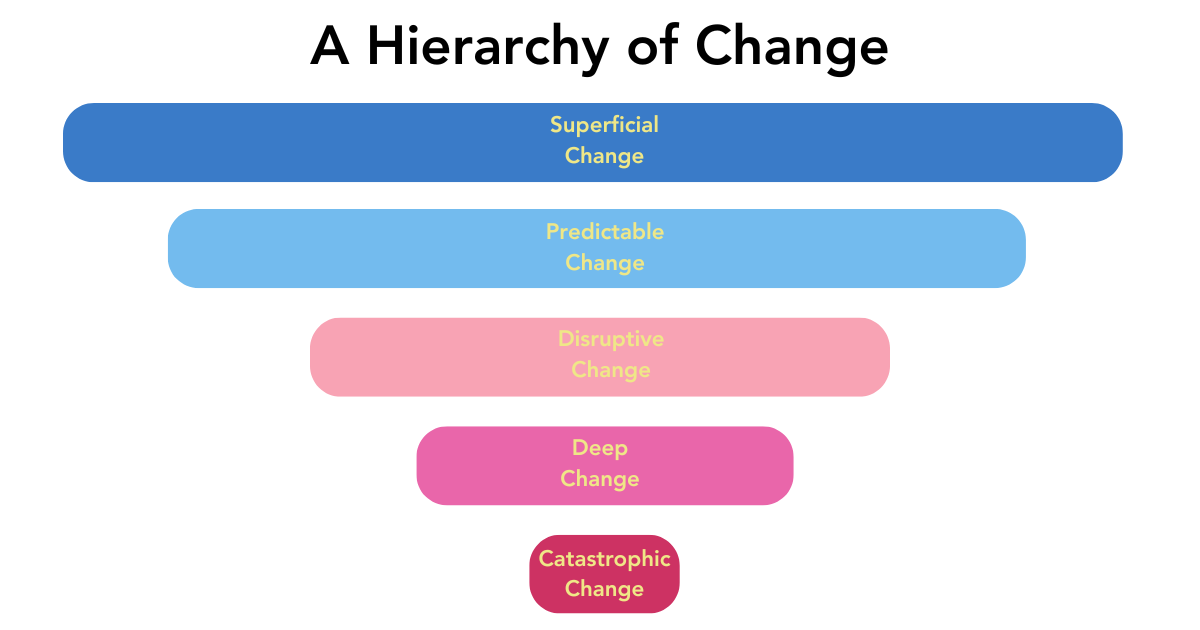
To begin, John developed a hierarchy of change informed by his original research, fieldwork and executive leadership experiences working in over 40 countries on the development of property systems and land information policy. Along the way, he co-founded an American-based technology consultancy, created a Peruvian international development company with economist Hernando de Soto, and served as President and Vice-Chancellor of the University of New Brunswick.
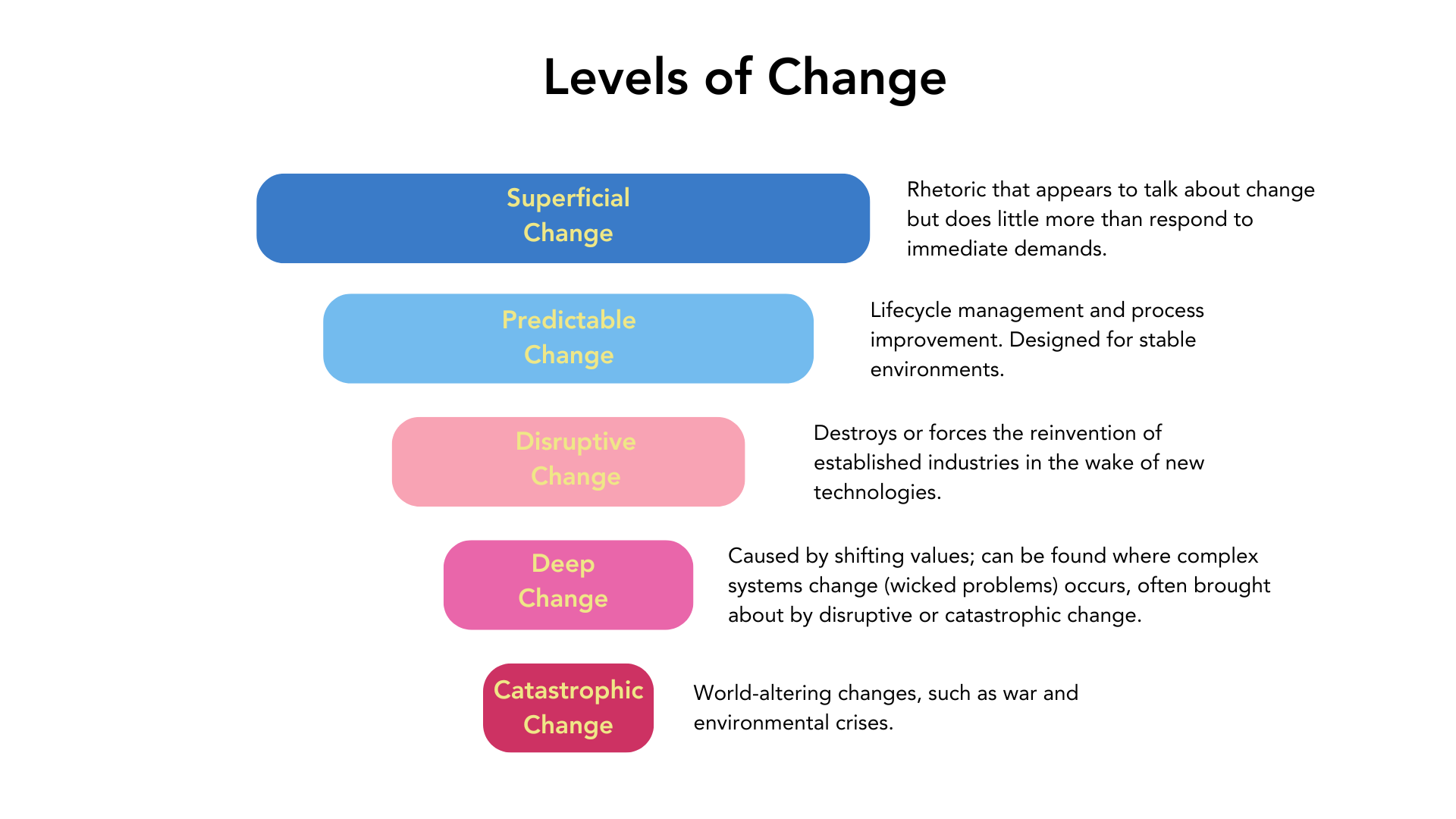
The first level of his hierarchy is superficial change, which is political rhetoric that appears to address change but does little more than respond to the immediate demands of voters, lobbyists, and party members.
The second level is regular and predictable change, which improves organizational efficiencies and performance, exemplified by Lean, Six Sigma, Kaizen, Total Quality Management (TQM) and other continuous process improvement methodologies.
The third level is disruptive change, which destroys or forces the re-invention of established industries in the wake of new technologies, best exemplified by the rise of digital and mobile technologies, which are radically changing a wide range of industries such as education, transportation, health, retail, media, energy and manufacturing.
The fourth level is deep change, which brings fundamental cultural and institutional change, forcing us to re-examine our core values and priorities. These shifting values cause great uncertainty and anxiety in our communities, resulting in a growing cultural divide. That divide is accelerated by digital media, which makes it easier for people to seek out information and opinions that reinforce their world view.
The fifth and final level is apocalyptic change, which is catastrophic, global destruction at the level of a world war or extreme climate change.
As with any emerging field, progress will be achieved through the collective work of people across sectors and jurisdictions who bring a diversity of perspectives, experiences and ideas to our shared purpose: to help guide our society’s transition in a way that provides the greatest amount of good with the least amount of harm.
What follows are a few observations garnered from our research, experiences and conversations with fellow practitioners that we offer as a starting point for developing a definition of deep change, and methodologies for working within it.
Existing management processes, perspectives and toolkits are insufficient for dealing with the complexities and interconnectedness of problems rooted in deep change.
To survive and hopefully thrive in this new reality, we need strategies that develop organically, can shift to accommodate society’s changing needs, and in the end can provide us with long-term economic stability. Traditional management practises, which are both a product and an impetus for the accelerated growth of capitalization post-WWII, can’t get us there. The emerging knowledge age is forcing a significant rethink of how we define economic value, expanding beyond simply products and services to include relationships, ideas and experiences. This has revealed the limitations of 20th century business processes.
First, most management practises are inherently self-interested. A common mistake is to believe the institutional or corporate perspective is also the wider community’s perspective. That doesn’t work within a deep change environment. Individual concerns must give way to a shared purpose to gain wide support from within the network. Failure to do this will leads to stalled conversations, protests and institutional inertia.
Second, traditional practises work best within narrowly defined problems. Most major management practises were developed to work within hierarchical institutional and corporate systems in order to manage and control change. While these processes have tried to adapt, each is challenged by the speed and fluidity of people, information and ideas that is the hallmark of deep change. The strongest solutions for issues of deep change tend to develop within multisectoral networks where leadership is both diverse and fluid in service to collaborative impact. We are moving from systems of control to networks of access and that requires a different type of roadmap.
Deep change problem-solving isn’t an either/or proposition; it’s and/and.
Issues of deep change share a common characteristic: an inability to develop a solution that serves two or more core principles that on the surface are in conflict with each other. We see this in fights that pit resource extraction against environmental concerns; public health care service delivery against rural communities; and public sector pensioners against central government. Each is a fight for fairness, and no side trumps the other. However, the self-interested nature of traditional management processes frames these issues as fights that only one side can win. Deep change requires the opposite; leaders who can work through competing demands to arrive at solutions that provide more help than harm to all involved.
Technology has changed how we engage with issues, from passive observers to active personal and communal leadership.
Massive technological change, such as what we are currently living through, does more than simply change the economy, it changes us and we have yet to fully grasp the implications of this change. We now live and work within a distributed network model, which works like personal communications only on a massive scale. It is a two-way exchange that helps us establish relationships, express our values, acquire knowledge and build trust.
This is the hallmark of our new, knowledge age: the mobility of people and information.
Show, don’t tell’ is an old journalism adage that is a great way to think about working, living and leading within a network.
The upending of traditional hierarchies means it is no longer enough for anyone, private citizens, public figures or institutional representatives to say they will do good; we each must illustrate it in tangible ways – and we must have an established track record of positive action long before trouble hits.
Why? Because in an era of uncertainty and deep change when values and cultures are in flux, odds are we are all going to be on the wrong side of an issue at some point. We just don’t know when or what the issue will be.
In a network, no one and no organization stands alone. We are our networks, which means we all judge and are being judged by our perceived values based on others’ interpretations of our present and past actions, as well as the behaviour of other corporate, political and community players in our space.
To avoid the scorn of public judgment, we must move from passive observer to active participant on issues that matter to us personally, to our employees and to the communities we serve.
It’s not enough to be a good public servant, politician, corporate or private citizen; we must be role models too.
Resilient and scalable solutions are anchored to place.
Historically, in times of stress and uncertainty, success has come to those organizations and communities that have been able to develop local solutions and scale up innovations.
However, out of fear and anxiety, people have often looked to a larger force to dictate a big idea because they are desperate for a solution. But this rarely works because for community innovation to take hold, it must start on the ground and scale up, so people feel ownership of the solution and are responsible for its success.
People want and need to participate in conversations that recognize their unique challenges and opportunities, and that show them how they can directly participate in making their communities better.
Fear and risk aversion stifles innovation at our peril.
To be successful in the knowledge age, jurisdictions will need to mix and merge information to curate new products, services, processes, relationships, experiences, policies and workflows.
This is the realm of innovation, but not the vaguely uplifting version made popular via social media memes and start-up pitch decks.
The innovation of deep change is rooted in our genes and the science of evolutionary biology.
In all societies, imitators far outnumber innovators, each making incremental changes to our collective body of knowledge.
Berkshire Hathaway CEO Warren Buffett famously opined in a 2008 Harvard Business Review article that there are three types of people in the world: innovators, imitators, and idiots.
If you’re lucky, you’ll meet the first, who see what others don’t; you can do business with those in the second group, who add to the work of the innovators; and you should avoid the third, because they are driven by greed, self-importance or both.
Traditional management and venture capital processes, which came to prominence in the final decades of the last century, are designed for the second group, the imitators who are best placed to capitalize on existing innovations.
This makes sense because the accelerated growth of mid to late-20th century capitalism was built upon already established values, policies and infrastructure.
Venture capital, the engine that has fueled the world’s start-up and entrepreneurial culture, is naturally drawn to ideas, products and services that can quickly commercialize, scale, and deliver a healthy return on investment.
It’s a system inherently weighted in favour of incremental change produced by that large pool of imitators.
That won’t be enough if we hope to make the leap into the knowledge age.
We need innovations that are purpose-led, community-focused and rely on the collective knowledge of the community that backs it.
When we believe in something, we take ownership of the ideas and the accompanying responsibility to nurture and guide these new purpose-led ideas to fruition.
That’s the innovation we seek.
It’s time to consider how we might use our collective knowledge and experiences in service to this shared purpose: to help each other safely navigate our way into our new age with empathy, openness, curiosity, patience and good humour.
Ideas connect us.
If this essay resonates with you, please share it. That’s how you can help us build a community of readers who care about supporting East Coast voices in our national conversation.
Support Local Storytelling & Reporting
Want more analysis like this? Becoming a paying supporter of Side Walks and follow our continuing coverage of the issues shaping Atlantic Canada’s future.
Stroll Over to Side Walks For More Stories


AI Summary: We are entering a period of deep change—a global transition driven by rapid technological disruption, climate change, economic instability, cultural polarization, and declining trust in institutions. These forces are reshaping how we work, govern, and build community. Traditional management practices, public policy tools, and organizational systems, designed for the industrial and post‑war eras, can’t address the complex, interconnected challenges of the emerging knowledge economy. To navigate this shift, we need new approaches grounded in shared purpose, multisector collaboration, place‑based innovation, and network‑driven leadership. Resilient solutions must balance competing principles, demonstrate values through action, and draw on the collective intelligence of communities. Success in the knowledge age will depend on our ability to foster trust, adaptability, inclusive decision‑making, and purpose‑led innovation that provides the greatest good with the least harm.