

New Brunswick Politics Isn't Volatile; Its Arithmetic
Canada's only bilingual province is called hard to govern. But the centre that decides its elections has no language, and it fires anyone who forgets.

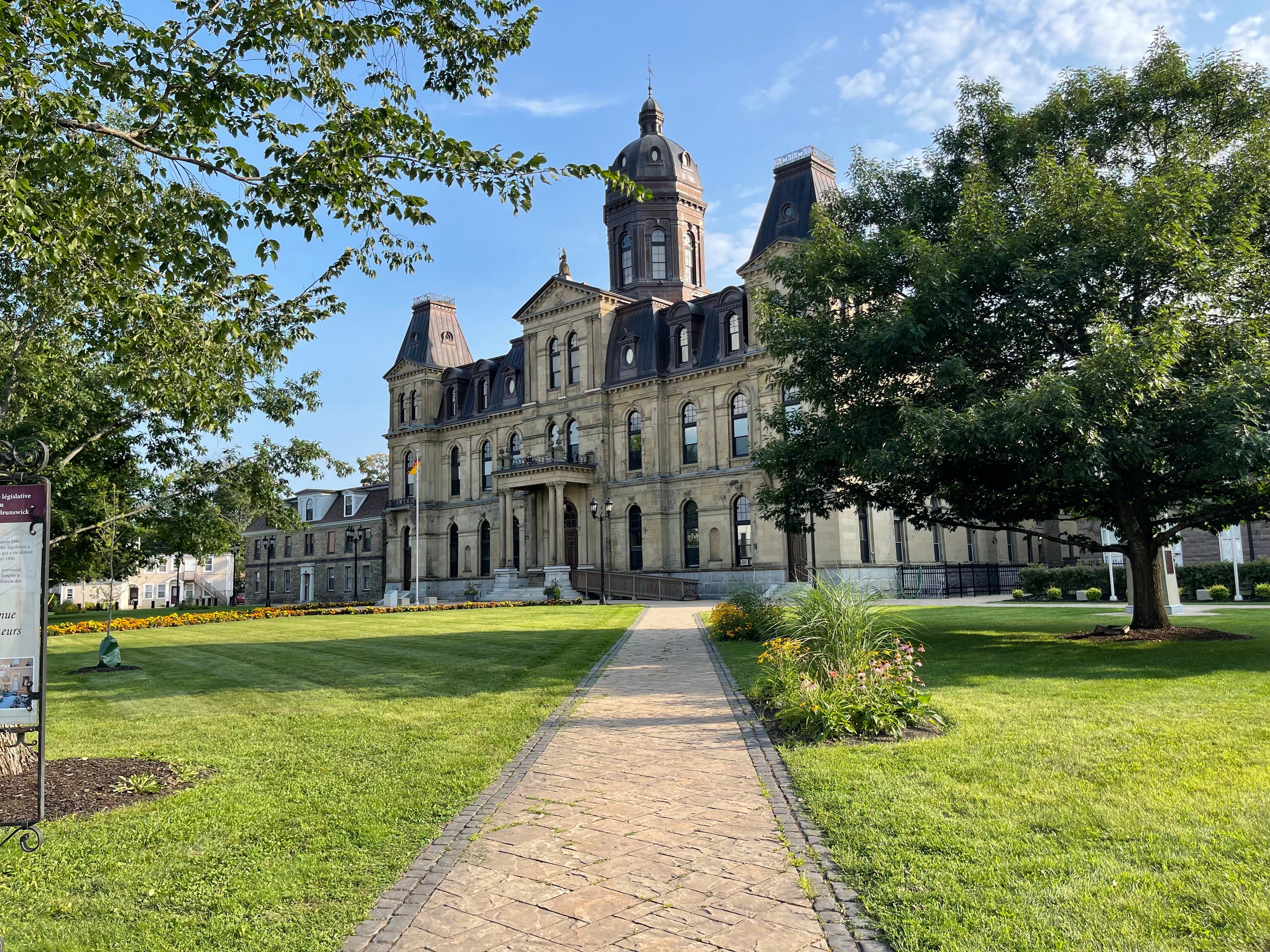
Today, we’re happy to publish a new piece from Louis Léger, reflecting on his 40+ years in provincial and national politics, and what the balance successful leaders must strike to succeed in New Brunswick.
Broadening our understanding of the East Coast.
If this story column your interest, please share it. Every share helps spread knowledge about the ins and outs of local affairs and keeps independent reporting strong on Canada’s East Coast.
Forty years ago, in 1985, Jean-Carol Pelletier, then chief of staff to a minister in the Mulroney cabinet, hired me for a summer job in Ottawa that would shape my adult life. Over lunch, he described in his way, the country I was about to work in. “In the Maritimes,” he said, “politics is a family business. In Quebec, it’s a religion. In Ontario, a business. In the Prairies, a cause and in B.C., it’s a circus.”
He was right about how people come to party politics in the Maritimes. Here, the party you support is often the one you were born into, and that inheritance is visible in every riding on the map.
But while party politics is a family affair in New Brunswick, how the general population votes is a different matter, something few outside the province understand, and why most outside pundits and organizers read this province wrong.
In New Brunswick, politics is arithmetic. Inherited allegiance fills the safe seats, but they’ve never decided an election.
For that reason, New Brunswick looks volatile from the outside. Since 2010, five elections have produced four premiers. But New Brunswick voters aren’t fickle; they fire for cause. I spent four decades inside that arithmetic, in Ottawa and in Fredericton, ending as Chief of Staff and Deputy Minister to a premier.
Defined by exile and return
New Brunswick is the only officially bilingual province in Canada. Roughly one-third of the province is francophone, most of them Acadians. About 270 years ago the British tried to erase their existence. Families were separated at the wharf, loaded onto ships and scattered through the colonies from Massachusetts to Louisiana, many became Cajuns. It was meant to be an ending, but the British had misjudged what the Acadians were willing to walk back for. They started again with nothing and, through hard work and extraordinary resilience, learned to thrive.
Acadians are not Québécois. Nobody here has ever marched to leave Canada; Acadians marched to return to it. The ambition, centuries in the making, was to build institutions: schools, hospitals, a university, and eventually recognition written into the Constitution of Canada. All of it sits on the territory of the Mi’kmaq and Wolastoqey, whose politics run on treaties older than the country, on a different axis than the one this essay describes. It should be said that without the Mi’kmaq and Wolastoqey, who hid, fed and supported the Acadians, many more would not have survived. Stories and culture deeply embedded in New Brunswick’s political soil.

New Brunswick is like most democracies; it does not elect governments, it fires them. What is rare is how attentively this one does it, and the turnover is the proof: Shawn Graham in 2010, David Alward in 2014, Brian Gallant in 2018, each election handed to the other party.
That last one broke a century-old pattern. For the first time since 1920, no party won a majority, and the Progressive Conservatives took power with fewer votes than the Liberals, only after Gallant lost the confidence of the legislature. Blaine Higgs looked like the exception. Voters re-elected him in 2020, in the middle of the pandemic, and turned that minority into a majority, something no New Brunswick minority government had ever done before. The seats that made the difference came from bilingual ridings in the southeast, none of them francophone-majority, and there were just enough of them.
Blaine Higgs looked like the exception. Voters re-elected him in 2020, in the middle of the pandemic, and upgraded his minority to a majority. Then they watched what he did with it, and in 2024, they fired him too, the first sitting premier to lose his own seat since 1987. This electorate keeps its own calendar. It watches, it gives second chances, and it collects. The firing squad has no party card.
What the firings enforce is the centre, and in Canada’s only officially bilingual province, the centre has no language. It was built, over 60 years, by people who decided that two communities sharing one small province had to be made to work. My father put it plainly, more than once: there are not enough boats to send us to Louisiana, so we had better get along. The voters who enforce that centre are protecting an inheritance, not expressing a temperament.
Lend me your vote
Centralist voters are the largest voting bloc, and they ask two things of their governments: fiscal discipline and cultural respect, held together. The fiscal half is specific. This province’s voters pay their fair share of taxes with little complaint. What it will not forgive is waste, unqualified patronage, and money moved without honesty.
Richard Hatfield held both halves longer than anyone. He won 39 of 58 seats in 1982, the largest majority his party had ever won, including 10 francophone ridings, because Acadians concluded a Conservative could be trusted with their institutions. My father was one of his ministers, a Conservative in Kent County, where he liked to say there were not enough Conservatives to elect a dog catcher. So his message to his voters was simple. Restez Libéral, mais prêtez-moi votre vote. Stay Liberal, and lend me your vote.
That is how power works in this province. Nobody converts. They lend, and they call in the loan the moment a government forgets whose votes it is holding.
Voters called it in on Hatfield five years later. By 1987, the government had been in office 17 years and had stopped noticing: self-centered, un-focused, undisciplined and a leader who delayed the vote to five years and a day, the longest the Constitution allowed. He lost all 58 seats to Frank McKenna, a Liberal running as a fiscal disciplinarian. No premier was ever a stronger guarantor of the cultural half than Hatfield, and he paid for it inside his own base, where many anglophone Conservatives resented his closeness to the Acadians. The scandals gave that resentment its exit. It did not save him that the Acadian ridings had lent him their votes twice. The good governance half was gone, and the firing squad marched into the voting booths.
Anger rises, then falls
The wipeout did not end the anger. Four years later, a party called the Confederation of Regions won eight seats and became the official opposition of New Brunswick on a single plank: ending official bilingualism. CoR was a Western party on paper, founded in Alberta in 1984 by the same current that would soon power Reform. But it was assembled in New Brunswick out of the wreckage of the Hatfield coalition, running former Tory MLAs and even former ministers, and its only electoral success anywhere in Canada came in anglophone New Brunswick. Reform reshaped the country. CoR went from official opposition to zero seats in four years.
The pain underneath was real. Mills closed, the cost of living climbed, and the feeling that decisions were made somewhere else. But when the mills closed in the Chaleur region, Acadiens never blamed anglophone regions for it. CoR took real hardship, oversimplified it, and gave it the wrong address. It did not fail because the hardship was invented. It failed because it blamed another community for a pain that the whole province shared, and out here, that is a ceiling, not a platform.
The anger returned in 2018 under a new name. The People’s Alliance ran against duality in health care and education, which in practice meant running against the Francophone community. It won three seats and held the balance of power in a minority legislature. National reporters wrote that the province was fracturing. Two years later, it was down to two seats and two years after that, in March 2022, the Party leader and his remaining colleague crossed the floor to the Progressive Conservatives, deregistering the party on his way out. Supporters revived it, and it ran 13 candidates in 2024 before folding for good in 2025. Its founder sat in a Progressive Conservative cabinet. CoR and the Alliance ran in anglophone ridings and died in anglophone ridings, refused by the very voters they claimed to speak for.
Some share of every electorate needs a grievance to organize around, and no amount of governing removes it. Here, that floor sits at a few percentage points, and it exists in both language communities. From 1972 to 1982, the Parti Acadien ran on carving a separate Acadian province out of the north and east; it never won a seat, folded after a decade, and nothing has replaced it since.
In 1999, Bernard Lord, a bicultural Progressive Conservative, won 44 of 55 seats, taking back the ridings CoR had carried and a majority of the Acadian seats. The formula does not belong to a party. It belongs to the voter, and the voter hands it to whoever can hold both halves.
A view from the inside
I was Chief of Staff to Blaine Higgs, the premier whose party absorbed the Alliance, and I managed the 2020 campaign that won him his majority through the bilingual southeast. I left at the end of 2022. Higgs had run for the leadership of CoR in 1989, and I am an Acadian from Kent County whose father sat in the cabinet of Richard Hatfield, the premier who did more than any other to entrench the very rights CoR was founded to repeal. I knew all of it going in and went anyway, because my family’s rule was that you do not make the case from outside the room. The 2024 result is the measure of how that case fared.
New Brunswick was the only province in Canada to come through the pandemic without a deficit. Net debt-to-GDP fell from roughly 40 per cent to 25, with $2 billion of debt paid down. The fiscal record stood with any government in the federation, but in 2024 the government still lost 33 of 49 seats, its remaining 16 confined almost entirely to anglophone New Brunswick. It had gone looking for fights its coalition never asked it to contest.
Why should a reader in Calgary or Toronto care? New Brunswick is often called Canada in miniature, two language communities obliged to govern together in one political space. The description is fair, with one difference. Federally, a party can win power almost entirely without sturdy Francophone support. Stephen Harper won his 2011 majority with five seats in Quebec. In New Brunswick, that path does not exist, because the seat count does not allow it.
That is also why the purity test now fashionable in some conservative circles has no relevance here. A purity test is a way of choosing a smaller coalition on purpose, and in a 49-seat legislature that walks both sides of a language line, a smaller coalition is an opposition bench. Those who insist on it get to watch government from the outside, which may be where they are most comfortable. While the country can postpone cultural conversations for an election or two, New Brunswick must settle it every single time.
Watch New Brunswick. Through six decades of language politics and party platforms built to exploit them, the voters of this province have never once handed power to the anger. They rent it, they discipline it, and they return, every time, to the centre. In a decade when politics almost everywhere is being pulled to the poles, that is worth noticing. Nobody here mistakes it for luck; that’s the work required to keep the family business together.
Support Local Storytelling & Reporting
Sign-up and subscribe to Side Walks and follow our continuing coverage of the issues shaping Atlantic Canada’s future.
Join Us On Side Walks For More Stories


 | A guest post by
|