

No People, No Money
New Brunswick’s soft economy made it reliant on federal transfers. Now, slower population gains threaten to reduce those transfers and widen a deficit the province can’t close on its own

Stay in the Know.
If this story piqued your interest, please share it. Every share helps spread knowledge about the ins and outs of local affairs and keeps independent reporting strong on Canada’s East Coast.
The Government of New Brunswick needs more people so it can receive more money.
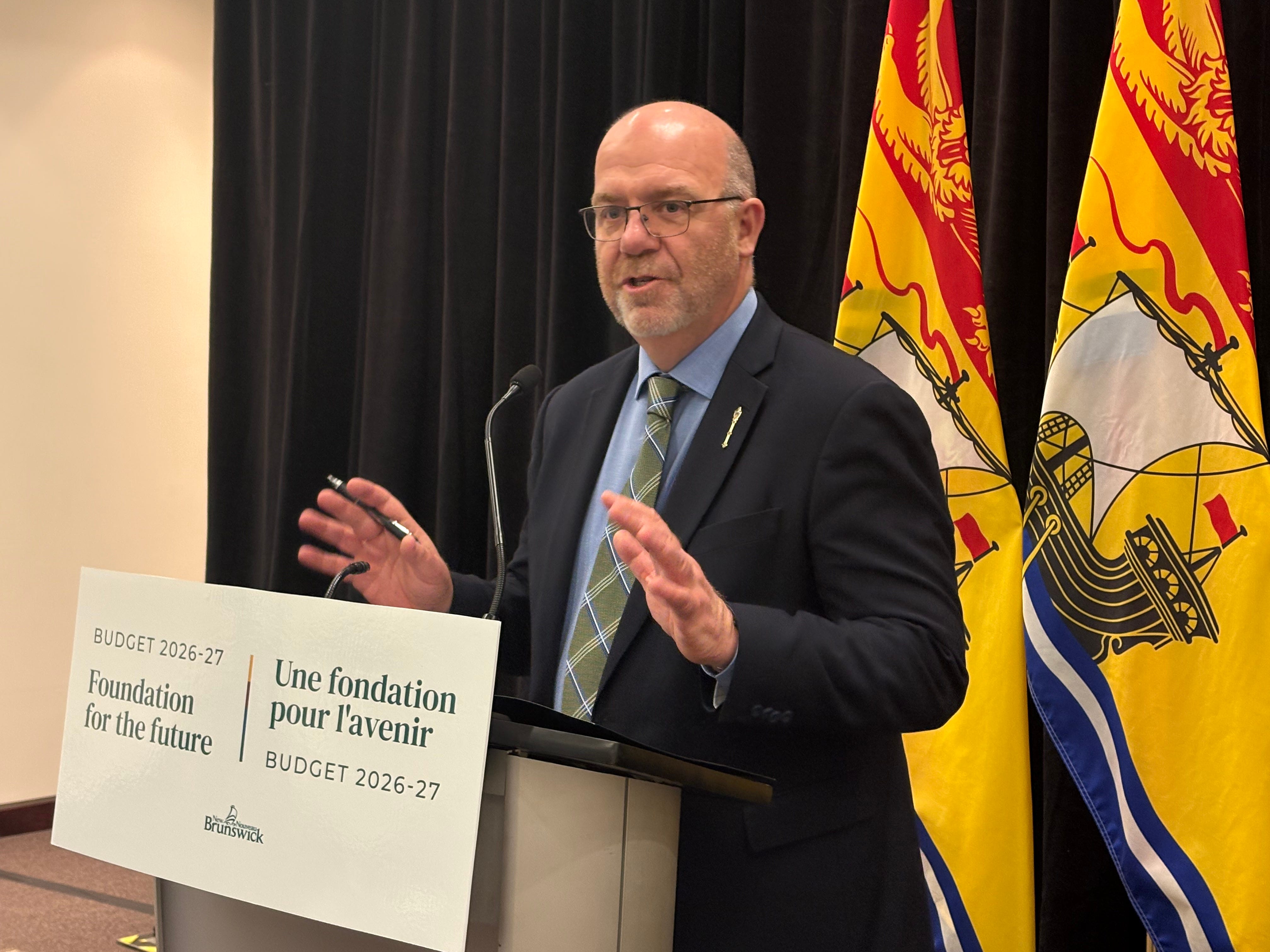
Provincial finance minister René Legacy delivered a St. Patrick’s Day budget that included a record-setting $1.39 billion deficit, an increasing debt burden and no obvious pot of gold.
It also revealed how dependent New Brunswick is on federal government policy, particularly immigration.
“The biggest thing that’s recently had an impact on our revenues was population growth,” said Legacy, during his budget day media briefing.
“If our population growth goes faster than other provinces, then our share of the transfers from Ottawa also grows.”
Although New Brunswick’s population continues to increase, sitting at 869,682 as of Canada Day, 2025, the government projects a tiny increase of 0.3 per cent in 2026.
“We’re still growing, but we’re growing at a slower pace than other provinces, so now our share [of transfer payments] is shrinking,” Legacy said. “So, with the new policies in the federal government around immigration, I think the key for us is...we can still keep lobbying to get more, but we need to keep whatever we get.”
Transfers to New Brunswick
The numbers show why that matters. The Department of Health’s budget now sits at $4.8 billion, accounting for roughly one‑third of all government spending and almost matching the combined value of the three major federal transfer payments, which are projected at $4.9 billion in 2026–27.
Those transfers help define Canadian federalism: equalization, the Canada Health Transfer, and the Canada Social Transfer, formulated to redistribute wealth so that provinces like New Brunswick can maintain comparable standards of health care, education and social supports despite having a weaker tax base.
For 2026–27, the provincial government estimates $3.36 billion from equalization, $1.2 billion from the Canada Health Transfer, and $376 million from the Canada Social Transfer. Together, federal transfers account for roughly 37 per cent of all provincial revenues.
While the province is banking on major projects – such as the proposed Sisson Mine, J.D. Irving’s planned Brighton Wind Farm, upgrades to its Saint John pulp mill, and upgrading NB Power’s Point Lepreau, which was allocated $9.9 million in the budget for additional nuclear development – to drive economic growth and, eventually, tax revenues, Legacy warned those benefits are neither immediate nor transformational on their own.
He offered a reality check: even a $1‑billion private‑sector investment might only translate into $30-$40 million in actual tax revenue for the province.
“You need a lot of those projects to really move the needle.”
There are indirect gains. Legacy pointed to the busy aggregate operations at the Port of Belledune and ongoing work at Mactaquac as examples of projects that put people to work, generate income taxes and support local businesses. But he stressed that New Brunswick lacks the kind of quick‑hit revenue source that other provinces enjoy.
“As much as our net debt‑to‑GDP is very good compared to other provinces, our issue is we’re not Alberta,” said the finance minister. “When oil goes up $30, $40, we don’t benefit as quickly. We need to have more structural industry to keep building forward.”
No Easy Fixes
That structural deficit looms over every decision in this budget. The province is forecasting a $1.39‑billion deficit in 2026–27, with it persisting through at least 2028–29, when the shortfall is still expected to be more than $1.2 billion and provincial debt will be approaching $20 billion.
Legacy argued that what’s on the table now is only the first phase.
“We’ve started… and it’s just the beginning,” he said. He noted that the out‑year projections are built on a set of assumptions and not all of the underlying decisions have been finalized. “There’s more decisions happening.”
Some of those decisions are already clear. The government plans to cut Part 1 of the civil service by 12 per cent through attrition over three years. Provincially owned heritage properties with fewer than 5,000 visitors will be transferred to community partners or shut down. Field veterinary services and provincial vet labs, including foreign animal disease services, will be phased out and handed to the private sector. A toll on non‑New Brunswick vehicles near Aulac is slated to be in place by 2028, with expected net revenues of about $10.4 million per year.
These moves are meant to chip away at what Legacy calls a structural deficit – the gap between what New Brunswickers expect from public services and what the province’s tax base can reliably support.
Asked why the government isn’t cutting more deeply now, given the scale of the shortfall, Legacy said that 82 per cent of the deficit is tied to the rising cost of existing services, not new political promises.
“Our campaign promises and our strategic government decisions only represent about 18 per cent, just a shade over $220 million,” he said.
Instead, the government is trying to buy time while it waits for long‑term industrial projects to come online and quietly hopes for more generous federal rules on immigration.
Legacy’s own answer suggests there is no easy way out. The province can’t get to balanced books quickly through private investment alone, it can’t cut its way there without undermining the very services residents demand, and it can’t count on federal transfers to keep rising if Ottawa’s immigration policy keeps New Brunswick’s population growth slower than the national average.
In this budget, the government has chosen to lean into record‑level deficits while it tries to stabilize health care, expand education supports and keep households afloat — a gambit that depends, more than ever, on decisions made in Ottawa and on whether newcomers to New Brunswick decide to stay.
Support Local Storytelling & Reporting
Want more analysis like this? Becoming a paying supporter of Side Walks and follow our continuing coverage of the issues shaping Atlantic Canada’s future.


