


Stay in the Know.
If this story piqued your interest, please share it. Every share helps spread knowledge about the ins and outs of local affairs and keeps independent reporting strong on Canada’s East Coast.
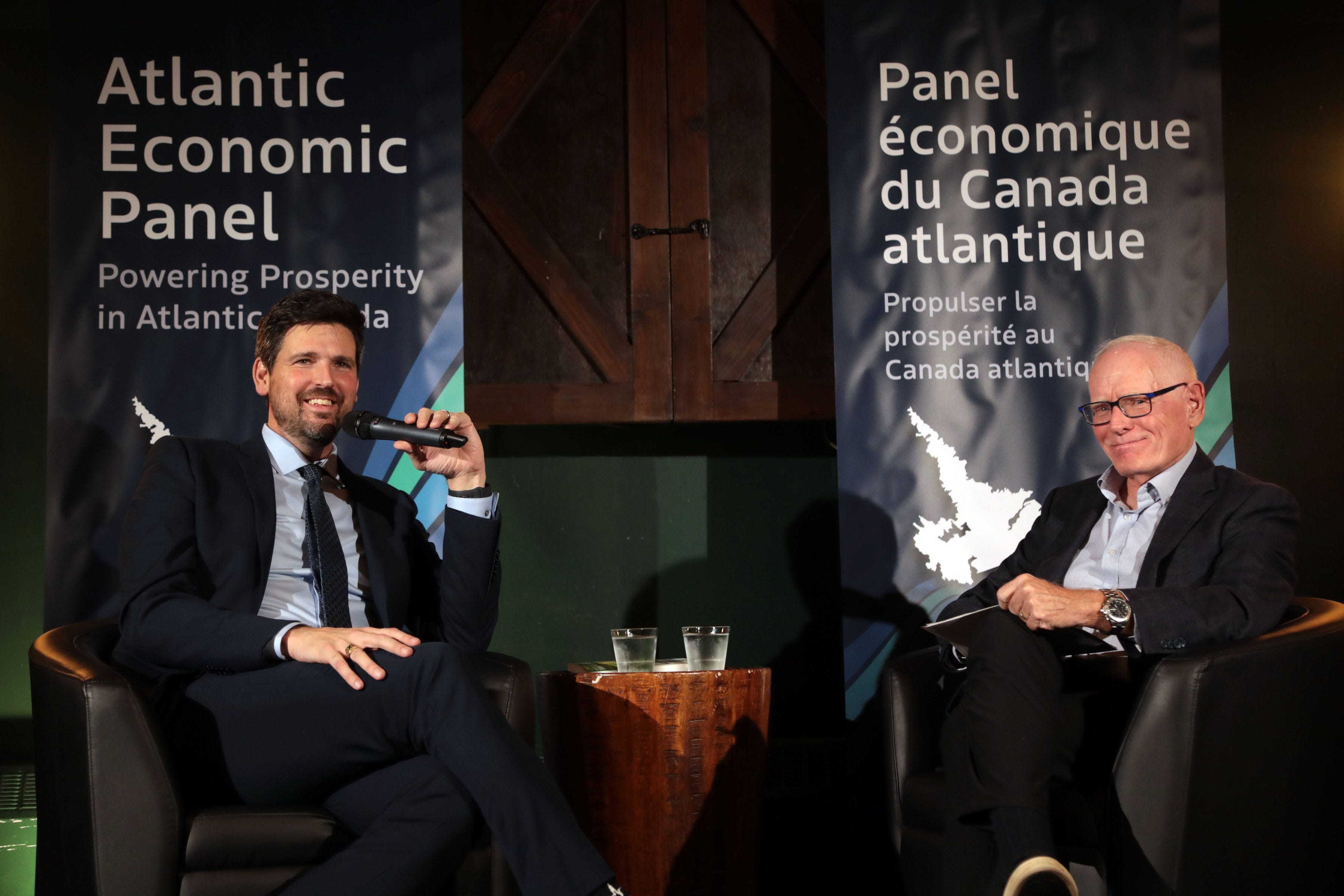
The federal government’s Atlantic Economic Panel is zeroing in on a single number: one per cent.
Chair Don Mills says the region needs to add roughly one percentage point to its annual GDP growth to stop falling behind the rest of Canada.
With a combined economy of about $118 billion, the four Atlantic provinces have underperformed the national growth rate for decades.
According to Mills, the Panel has a specific definition of ‘transformational’ economic growth: lifting Atlantic Canada’s annual GDP growth by about one point above its recent baseline and then sustaining it for the long-term.
To put it plainly, the panel wants to know: Where does that extra one per cent come from, and what has to change to unlock it?
That’s what they’ll be asking when they meet with business leaders and policy makers in Charlottetown, PEI, on February 12th and 13th, and in St. John’s, NL, on February 18th and 19th, following its January meetings in Halifax, NS and Fredericton, NB.
Joining Mills on the Panel are: entrepreneur, former Newfoundland finance minister, and co-founder of Sandpiper Ventures, Cathy Bennett; Joyce Carter, Halifax International Airport Authority President and CEO Joyce Carter; Cassidy Group (Coach Atlantic; Maritime Bus) CEO Mike Cassidy; McCain Foods chairman, former Maple Leaf Foods senior executive and investor, J. Scott McCain; former Canadian Armed Forces member and Pabineau First Nations Chief Terry Richardson; and Bank of Canada lead director and CEO and principal shareholder of Seafair Capital, Anne Whelan.
GDP is the total value of goods and services produced in an economy. Governments track it because when GDP increases, it is a sign that the economy is producing and earning more, largely via consumer spending, business investment, government spending, and exports.
Compared to the rest of Canada, Atlantic Canada has less people, less large industries, lower levels of private sector investment, and higher levels of government spending, most notably through public sector employment.
The result is GDP rises more slowly.

“For the last 60 years, we, on average, have performed by about 1 per cent less than everywhere else in Canada,” said Mills. “We’ve grown smaller as an economy, smaller as a population, because we couldn’t keep up with average growth for the country.”
That long-term underperformance, Mills argues, is structural rather than cyclical. It’s why the panel is narrowly focused on the kinds of changes that can boost growth and productivity, not on solving all of the problems facing the region.
In addition to its invitation-only, in-person conversations, the Panel has a survey and questionnaire for citizens to complete and offer perspectives on a way forward for the region. Both can be found on the Panel’s website. The panel will submit its final report by September 2026.
A Narrow Mandate
“Our mandate is pretty clear,” he says. “Transformational economic growth and improving productivity. That’s it in a nutshell.”
Mills says if ideas can’t illustrate how to move the growth and productivity dial, it’s not the panel’s priority.
For each sector, the core question is: What would it take for this sector to generate a meaningful share of that extra 1 per cent growth?
This approach, says Mills, deliberately avoids vague recommendations.
“We’re not going to say, ‘oh, we should have more energy,’” Mills says. Instead, the panel aims to recommend roadmaps that define what has to change, which rules or processes must be reformed, what infrastructure is needed, and who has to move first.
“If you discover gold in Nova Scotia,” Mills says, “it could take you up to 17 years to get approval to actually develop the mine.” New Brunswick, he notes, faces similar timelines. Few investors can wait a generation to see a return.

Setting the Table for Greater Integration
For a panel tasked with lifting GDP growth, regulatory reform and predictability are central levers to driving change.
Core to this for Mills is regional integration.
Mills wants Atlantic Canada to act like a common market within the federation: shared incentives for investment, streamlined and reciprocal regulations, and seamless movement of goods, services, and people.
“What if we, in Atlantic Canada, created an economic free trade zone,” he said, explaining this would mean credential recognition, regulations, and investment incentives are effectively the same across the four provinces.
He argues the region is culturally and socially better positioned for this than anywhere else in the country. Families, businesses, and institutions are already highly interconnected across provincial lines. The missing piece is political and regulatory alignment, too often blocked by electoral cycles and personality clashes.
Nowhere is the cost of fragmentation more visible than in energy.
Atlantic Canada, Mills points out, has almost every form of energy resource within a relatively compact geography: hydro, tidal, wind, and more. He believes the region could be a major contributor to Canada’s green energy ambitions, moving from a net importer to energy independent, then to a net exporter.
But that requires what he calls integrated energy planning.
Long‑term (25–50 year) forecasts of demand;
Clear decisions about which sources of energy will meet that demand most efficiently and sustainably;
And, critically, a regional transmission and infrastructure plan to move energy where it’s needed.
Today, Mills says, governments tend to advance isolated projects—a wind farm here, a nuclear proposal there, a tidal project somewhere else—without a regional systems operator or coherent architecture tying them together.
Recent near‑failures of the grid in Newfoundland, which could have pulled down parts of the Maritime system, are, in his view, stark reminders of the cost of that disjointed approach.
If Atlantic Canada can’t coordinate on energy, he suggests, it will struggle to meet its own needs, let alone capture the opportunity to export clean power to the rest of Canada and beyond.
Mills believes there is more support today for big infrastructure and economic integration than there was a decade ago.
“I do think that this is a moment,” he says. “And it may not last very long.”
Support Local Storytelling & Reporting
Want more analysis like this? Becoming a paying supporter of Side Walks and follow our continuing coverage of the issues shaping Atlantic Canada’s future.
Stroll Over to Side Walks For More Stories


AI Search Summary: This story reports on an interview with Don Mills, chair of the federal Atlantic Economic Panel, about the region’s long‑term GDP underperformance and the panel’s focus on identifying how Atlantic Canada could add an extra one per cent to annual economic growth. The piece outlines the panel’s mandate, its sector‑by‑sector consultations across the Atlantic provinces, and its exploration of regulatory reform, regional integration, and energy planning as potential drivers of higher productivity and sustained growth.